





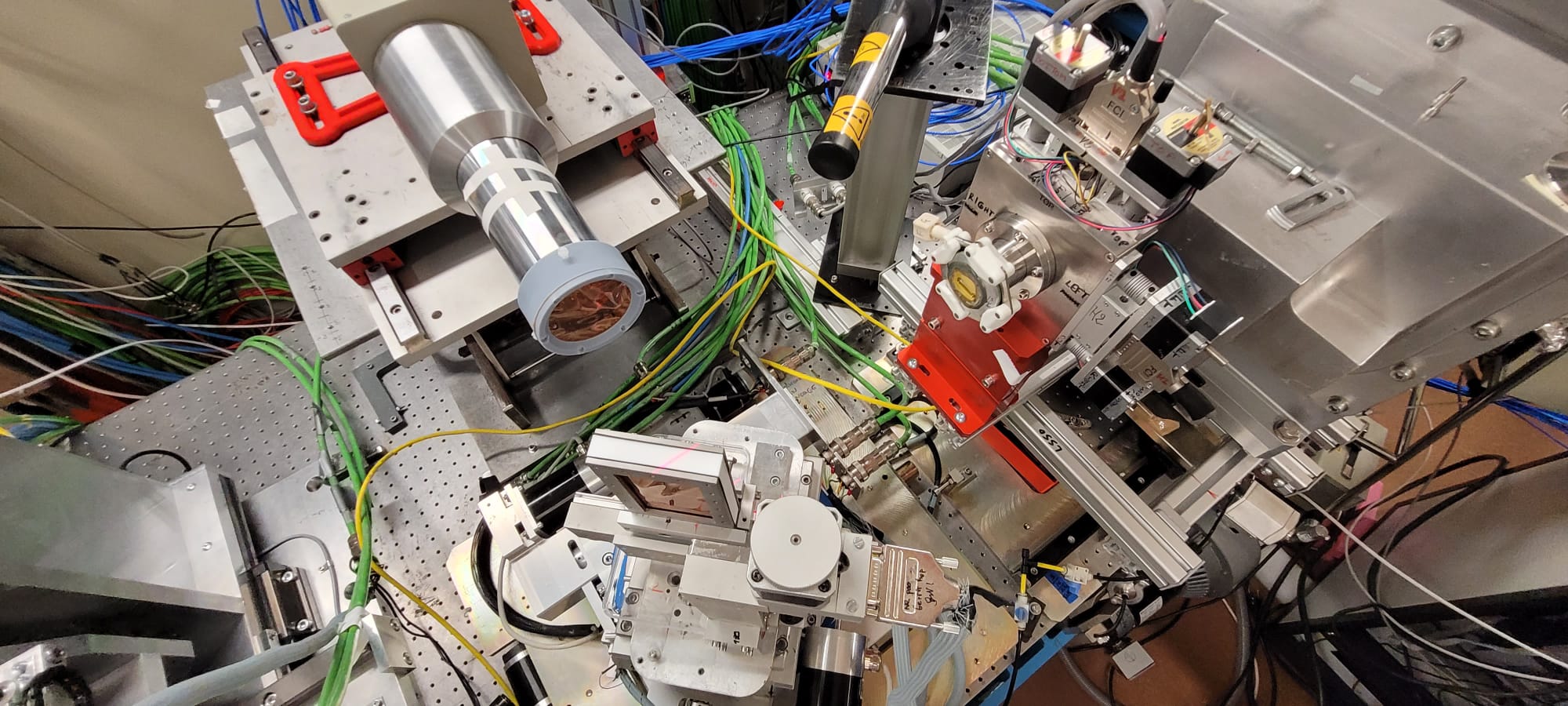
Protactinium, a radioactive element discovered over a century ago, still holds many secrets. An international collaboration involving researchers from IJCLab has just resolved ambiguities that have intrigued the scientific community for decades concerning the nature and stability of the characteristic chemical bond of this singular actinide. Photo: Set-up of the MARS beamline at the SOLEIL synchrotron
An element with unique chemical properties
Among the actinides, those heavy elements whose isotopes are all radioactive, protactinium (Pa) holds a special place. Unlike its neighbours in the periodic table such as uranium, which form a linear structure in solution called an "actinyl ion" featuring two bonds with oxygen, pentavalent protactinium exhibits only a single short bond with oxygen, known as "mono-oxo". This peculiarity raises a fundamental question: is this mono-oxo bond stable, or does it disappear depending on the chemical environment?
Previous studies had shown that this bond could vanish in the presence of certain ligands such as fluoride ions. Moreover, a persistent discrepancy existed between experimental measurements and theoretical predictions regarding the length of this bond: experiments indicated approximately 1.75 Å, while quantum chemistry calculations predicted closer to 1.85 Å.
Large-scale facilities at the service of radiochemistry
To resolve these ambiguities, a team of researchers from IJCLab (CNRS/IN2P3, Université Paris-Saclay), PhLAM (CNRS/Université de Lille), ISCR (CNRS/Université de Rennes), the SOLEIL synchrotron and CEA DAM chose to study the behaviour of protactinium in a chloride medium, a weakly complexing environment likely to preserve the mono-oxo bond. Measurements were carried out on the MARS beamline at the SOLEIL synchrotron, a particle accelerator producing extremely intense X-ray radiation that enables probing the immediate chemical environment of an atom through X-ray absorption spectroscopy.
Two samples were prepared under very different acidity conditions: one at moderate concentration (3 M hydrochloric acid), the other under extreme conditions (12 M). Analysis of the EXAFS (Extended X-ray Absorption Fine Structure) and XANES (X-ray Absorption Near Edge Structure) spectra, combined with relativistic quantum chemistry calculations essential for modelling these heavy elements, enabled precise characterisation of the chemical species formed.
Results that reconcile theory and experiment
The results obtained are remarkable in several respects. The mono-oxo bond persists under both conditions studied, including at very high chloride concentration, contrary to what had been observed in fluoride media. This unexpected stability under extreme chemical conditions opens new perspectives for understanding the behaviour of this element. Furthermore, for the first time, the experimentally measured bond distance (approximately 1.83 Å) agrees perfectly with quantum chemistry calculation predictions, resolving a disagreement that had persisted for several years.
The analysis also enabled identification of the chemical species present in solution: oxo-chloro complexes with seven-fold coordination, with a hydroxide or chloride ligand in the trans position relative to the oxo bond depending on the acidity of the medium.
IJCLab's radiochemistry expertise
Studying protactinium represents a considerable experimental challenge: this alpha emitter requires specialised facilities and strict radioprotection protocols. Melody Maloubier and Claire Le Naour, researchers at IJCLab’s Energy & Environment pole and experimental authors of the article, coordinated sample preparation and data acquisition in the laboratory's facilities dedicated to actinide handling (hot chemistry laboratory).
These results constitute a significant advance in understanding the chemical behaviour of actinides and pave the way for new investigations into protactinium speciation in other media. This fundamental knowledge finds applications in the nuclear fuel cycle domain, where mastering the chemical behaviour of actinides is essential for reprocessing and radioactive waste management.
Find out more:
La chimie du protactinium revisitée par les calculs quantiques