





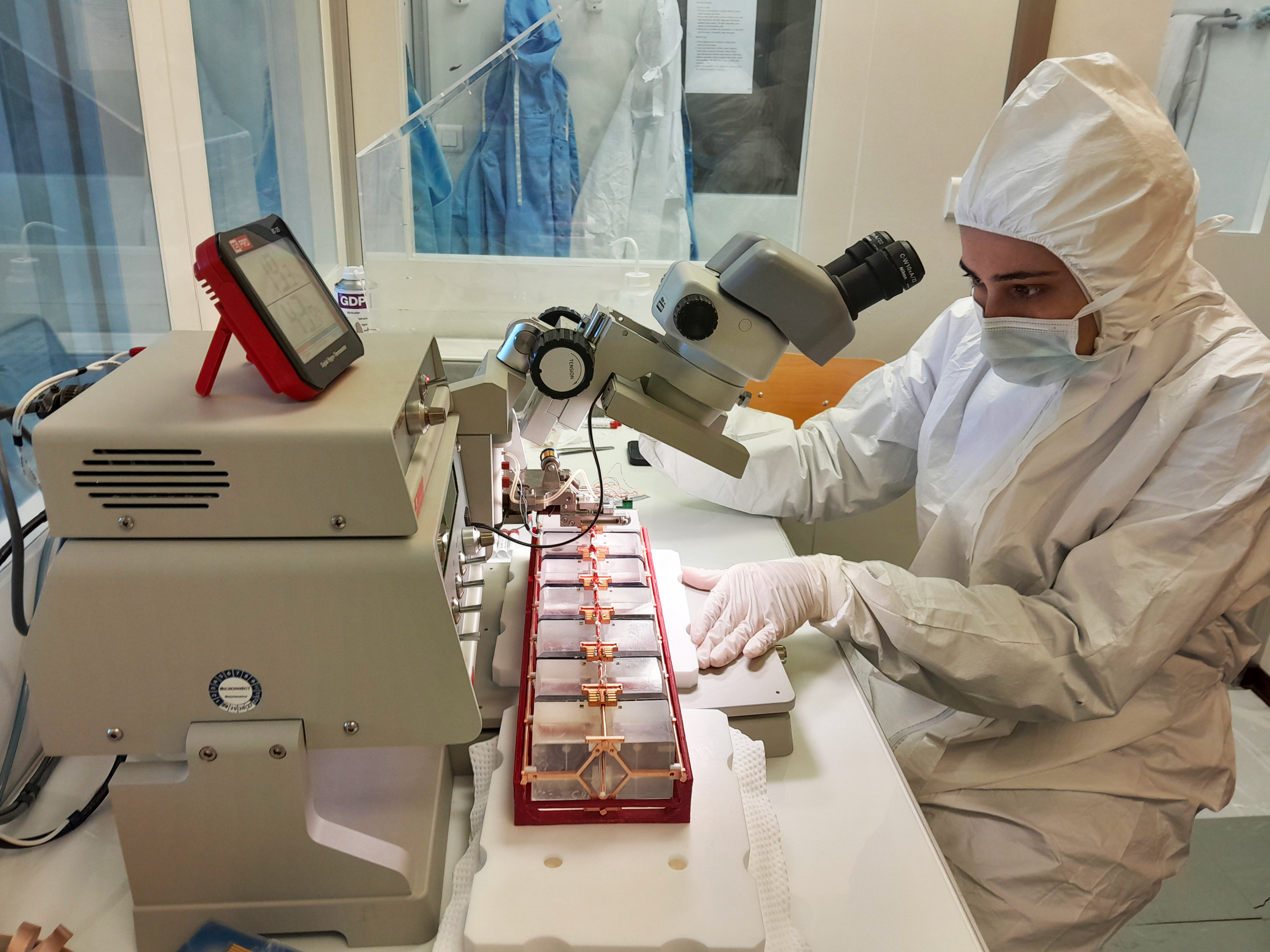
The CROSS experiment, designed and led by IJCLab, has just begun data collection at the Canfranc Underground Laboratory. Its goal: to observe neutrinoless double beta decay, a never-before-detected phenomenon that would reveal a new facet of physics. Cover image: ultrasonic bonding of CROSS temperature sensors carried out in an IJCLab cleanroom. © IJCLab
Beneath the Spanish Pyrenees, 36 detectors are scrutinising molybdenum-100 at just a few millikelvins above absolute zero. They are tracking a nuclear process so rare that its half-life would exceed 1025 years, a million billion times the age of the Universe.
"The discovery of this phenomenon would show that the neutrino is its own antiparticle," explains Andrea Giuliani, researcher at IJCLab and scientific coordinator of the experiment. Such a property would shed light on the origin of neutrino mass and the imbalance between matter and antimatter in the Universe.
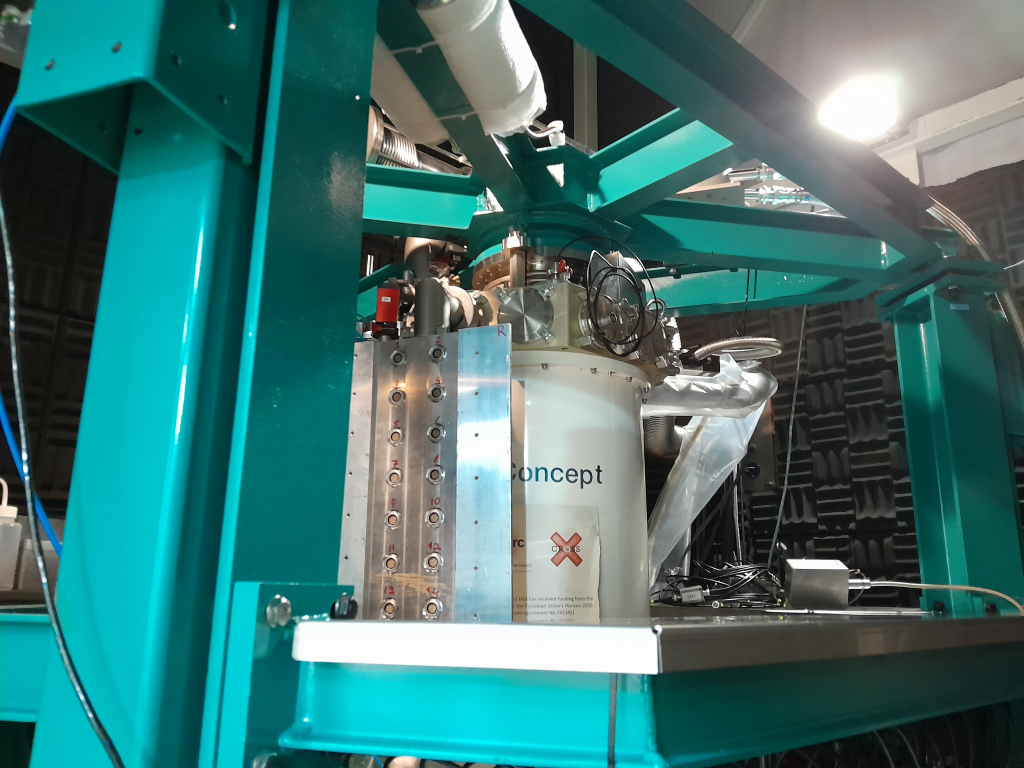
Cryostat of the CROSS experiment in its anti-microphonic hut at the Canfranc Underground Laboratory. © IJCLab
An experiment born in Orsay
The project was launched in 2018 as part of an ERC grant. Today, the ASSD group within the Astroparticle, Astrophysics and Cosmology (A2C) division and the Detector division at IJCLab provide the technical and scientific coordination of the experiment. The final detector was built in the cleanrooms on the Orsay campus, with a significant contribution from Irfu (CEA Saclay).
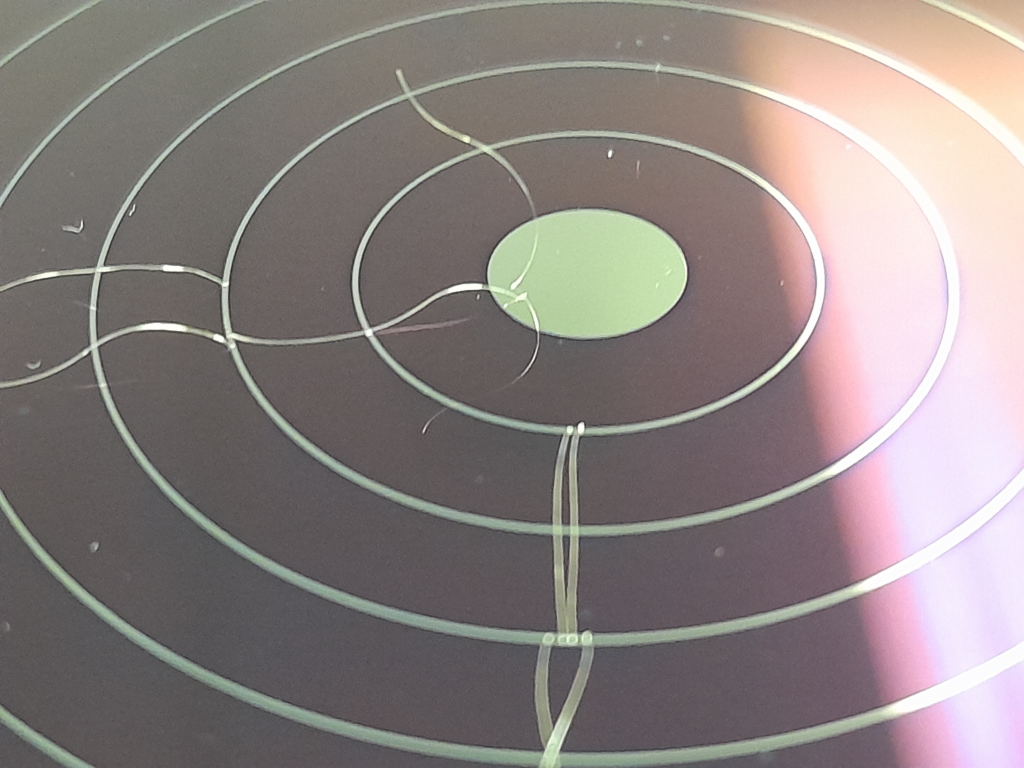
Light detector from the CROSS experiment: the concentric annular aluminium electrodes used to produce the Neganov-Trofimov-Luke effect are visible. © IJCLab
The key innovation lies in the light detectors developed by the ASSD group. Composed of thin slices of ultra-pure germanium and silicon, they capture the faint glow emitted by the crystals during a decay event. The signal is then amplified using aluminium electrodes deposited with the laboratory's evaporators. This technology makes it possible to distinguish the sought-after event from background noise.
A stepping stone towards the next generation
CROSS serves as a demonstrator for CUPID, the future large-scale experiment that will succeed CUORE at the Gran Sasso Laboratory in Italy. The light detectors designed at IJCLab will equip the 1600 crystals of this future instrument.
Data analysis for CROSS is also coordinated by the ASSD group. The first physics results are expected in 2026, with the ambition of setting the world's best limit on the neutrinoless double beta decay of molybdenum-100.
To learn more about the scientific context, read the full CNRS article..