






For forty years, physicists searched for "cold" dark matter. A team including Yann Mambrini, a theoretical physics researcher at IJCLab, demonstrates that it could have been born at near-light speeds before cooling down. This paradigm shift, published in Physical Review Letters, proposes a new production mechanism that predicts light dark matter with weak but detectable interactions. An ideal target for the DAMIC-M and TESSERACT experiments.
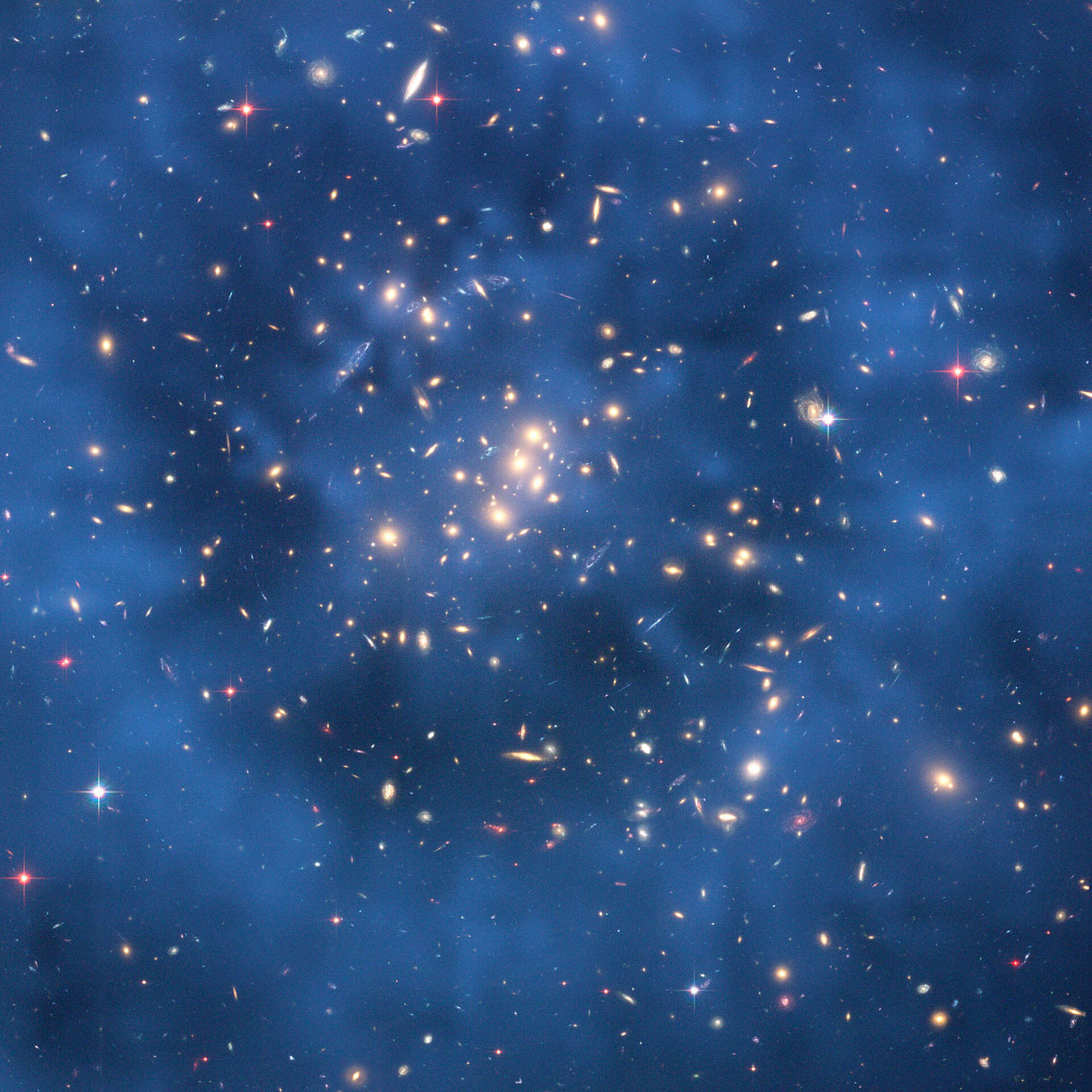
Cover image: a dark matter ring in the galaxy cluster ZwCl0024+1652. Photo credit: NASA, ESA, M. Jee and H. Ford (Johns Hopkins University)
Dark matter must be "cold": this postulate has guided research since the 1980s. If too fast, it could not have clumped together to form the structures we observe today. This is why two candidates were considered. On one hand, WIMPs (Weakly Interacting Massive Particles), these hypothetical, relatively heavy particles would have been in thermal equilibrium with the primordial universe before "freezing out" when the temperature dropped. Their interactions, although weak, should be detectable. On the other hand, FIMPs (Feebly Interacting Massive Particles): their interactions are so minute that they never reach thermal equilibrium, instead accumulating gradually in the universe. This "freeze-in" production makes them virtually impossible to observe directly. Yet, despite ever more sensitive detectors, no WIMP has been observed. FIMPs, by their very nature, elude all detection. This double dead end led Stephen Henrich and Keith Olive (University of Minnesota), in collaboration with Yann Mambrini (IJCLab), to revisit a long-standing idea.
A paradigm shift
As early as 1966, Gershtein and Zeldovich had proposed that dark matter could "freeze out" at relativistic speeds, like neutrinos. The idea was quickly abandoned: dark matter moving that fast would prevent galaxy formation. For forty years, no one thought to revisit this hypothesis.
Standard models assume that the "reheating" following cosmic inflation is instantaneous. By dropping this assumption, everything changes: if dark matter decouples during the reheating phase, it can be born ultra-relativistic and then cool down naturally. The universe expands faster than the particles travel, diluting their kinetic energy before galaxies form.
This mechanism, dubbed UFO (Ultra-relativistic Freeze-Out), does not predict a new particle but a new production mode. It results in dark matter with intermediate characteristics: lighter than standard WIMPs, with stronger couplings than FIMPs. In other words, dark matter that is both light (between a few keV and a few GeV) and detectable.
IJCLab at the forefront of detection
The DAMIC-M experiment, at the Laboratoire Souterrain de Modane, published in March 2025 the world's best constraints on dark matter–electron interactions for masses between 1 MeV and 1 GeV, precisely the range predicted by the UFO model. The IJCLab team contributes to several key components of the project (radiation shielding, installation and data analysis).
The TESSERACT experiment, an international collaboration involving IJCLab, IP2I Lyon and LPSC Grenoble, is preparing the next generation of detectors. Its superconducting sensors, operating at 8 millikelvins, have already probed previously unexplored masses (44 to 87 MeV). The full detector is expected to be installed at the LSM around 2029.
This scenario opens an unprecedented window onto the post-inflation reheating phase, a period that has until now been inaccessible to observation. Direct detection experiments could thus reveal not only the nature of dark matter, but also the extreme conditions that prevailed a fraction of a second after the Big Bang.
Read more:
Reference: S.E. Henrich, Y. Mambrini, K.A. Olive, Physical Review Letters 135, 221002 (2025). DOI: 10.1103/zk9k-nbpj https://arxiv.org/pdf/2511.02117
In the media:
Presse :
- SciNews - « Physicists Challenge Long-Held Assumptions about Nature of Dark Matter »
- SciTechDaily — « The Big Bang's Biggest Mystery: Dark Matter May Have Been Red Hot at Birth »
- Innovation News Network — « Dark matter may have begun much hotter than scientists thought »
- Science Daily — « Early universe dark matter born red hot before cooling »
- Space Daily — « Early universe dark matter born red hot before cooling »
- Phonandroid — « La matière noire pourrait venir d'une phase brûlante de l'univers primitif »
- Le Figaro — « La théorie du gel ultrarelativiste : une nouvelle hypothèse sur les origines de la matière noire »
- The Brighter Side — « Scientists reveal how dark matter formed in the early universe and why it's still here »
- Berliner Zeitung — « Dunkle Materie könnte bei ihrer Entstehung extrem heiß gewesen sein »
- Correio Braziliense — « Nova teoria desafia conhecimento sobre matéria escura »
- Cikavosti — « Nova teoriya zminyuye uyavlennya pro pokhodzhennya temnoyi materiyi »
- Académie polonaise des sciences — « Fizycy podważają klasyczny model ciemnej materii »
Radio :
- Alternantes FM — « Un parcours dans l'espace-temps »
- Descopera — « Materia întunecată mai fierbinte la începutul universului decât se credea până acum »
Podcast :
Video :
Presse :
- SciNews - « Physicists Challenge Long-Held Assumptions about Nature of Dark Matter »
- SciTechDaily — « The Big Bang's Biggest Mystery: Dark Matter May Have Been Red Hot at Birth »
- Innovation News Network — « Dark matter may have begun much hotter than scientists thought »
- Science Daily — « Early universe dark matter born red hot before cooling »
- Space Daily — « Early universe dark matter born red hot before cooling »
- Phonandroid — « La matière noire pourrait venir d'une phase brûlante de l'univers primitif »
- Le Figaro — « La théorie du gel ultrarelativiste : une nouvelle hypothèse sur les origines de la matière noire »
- The Brighter Side — « Scientists reveal how dark matter formed in the early universe and why it's still here »
- Berliner Zeitung — « Dunkle Materie könnte bei ihrer Entstehung extrem heiß gewesen sein »
- Correio Braziliense — « Nova teoria desafia conhecimento sobre matéria escura »
- Cikavosti — « Nova teoriya zminyuye uyavlennya pro pokhodzhennya temnoyi materiyi »
- Académie polonaise des sciences — « Fizycy podważają klasyczny model ciemnej materii »
Radio :
- Alternantes FM — « Un parcours dans l'espace-temps »
- Descopera — « Materia întunecată mai fierbinte la începutul universului decât se credea până acum »
Podcast :
Video :