





By combining Run 2 and Run 3 data from the LHC for the first time, the international ATLAS Collaboration, which includes physicists from IJCLab, pushes back the limits on Higgs boson pair production. Published in Physics Letters B just weeks before the end of Run 3, these results pave the way towards a direct measurement of the Higgs boson self-coupling.
The discovery of the Higgs boson in 2012 at the LHC provided the missing piece of the Standard Model. Since then, this particle's couplings to fermions and vector bosons have been measured with ever-increasing precision. The Higgs self-coupling, however, remains to be determined directly. This parameter is linked to the shape of the Higgs potential. It governs the exact nature of electroweak symmetry breaking, the mechanism behind the mass of elementary particles. The only direct experimental route to this self-coupling is the simultaneous production of two Higgs bosons.
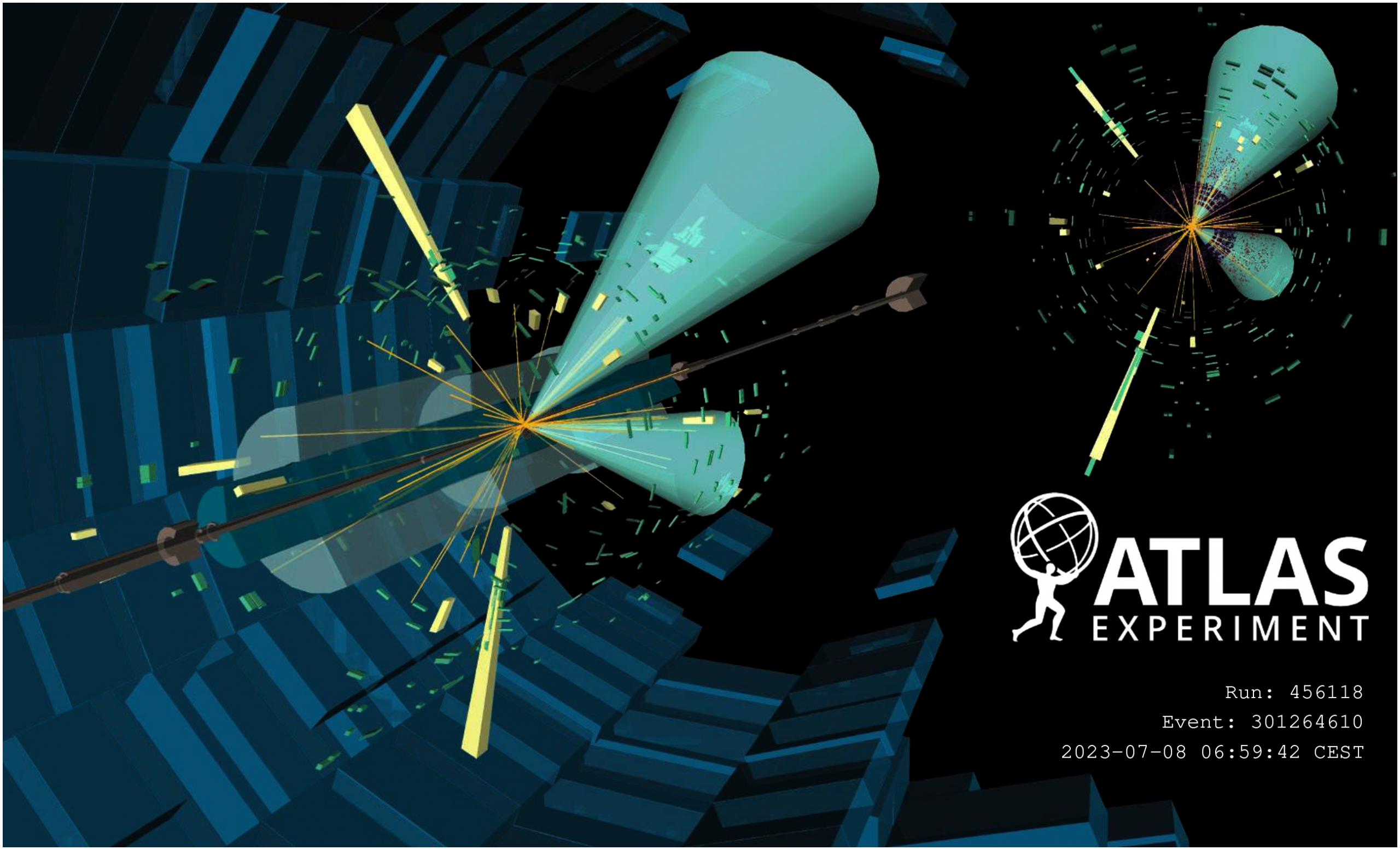
ATLAS studied one of the "golden" decay channels of this pair. One of the two bosons decays into two photons, the other into a pair of bottom quarks. This HH→bbγγ channel offers a favourable balance between signal rate and experimental signature clarity. It is nonetheless particularly demanding: di-Higgs production occurs only about once in every trillion proton-proton collisions. Standard Model processes producing a similar final state also constitute significant background. To discriminate between them, ATLAS physicists used machine learning algorithms.
The researchers analysed the full Run 2 dataset (2015–2018) along with partial Run 3 data (2022–2024). This is the first ATLAS measurement based on more than 300 inverse femtobarns (fb⁻¹) of proton-proton collisions. The limits set on the di-Higgs production cross-section are comparable to those obtained by combining all ATLAS di-Higgs analyses based solely on Run 2 data. The current sensitivity corresponds to approximately one standard deviation.
The completion of Run 3, scheduled for 29 June 2026, is expected to increase the data volume by a factor of 1.5. Evidence for di-Higgs production, exceeding the three-standard-deviation threshold, could be reached in the coming years by combining several decay channels and the results from the ATLAS and CMS collaborations. The High-Luminosity LHC era, expected from 2030 onwards, will then open the conditions needed for a precise measurement of the Higgs boson self-coupling.
Reference: Phys. Lett. B 876 (2026) 140280