





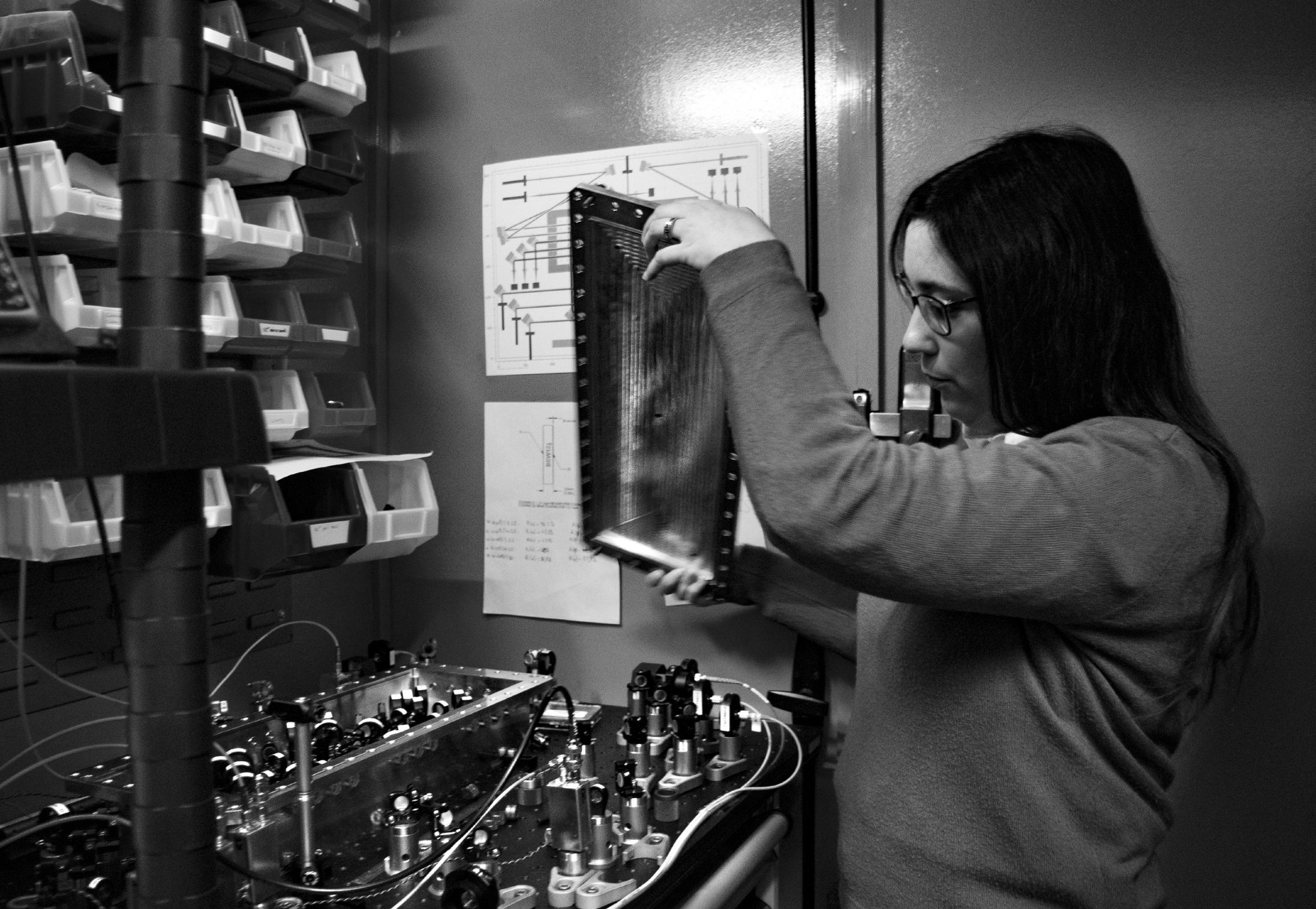
Angélique Lartaux, a researcher at IJCLab (on the cover : photo by Jean-François Dars), takes up her role as deputy spokesperson of the Einstein Telescope collaboration alongside the new spokesperson Michele Maggiore. Their three-year term begins on 23 March 2026.
The Einstein Telescope collaboration has designated its new spokesperson team. Angélique Lartaux, a researcher at IJCLab, has been appointed deputy spokesperson. She will form a partnership with Michele Maggiore, a theoretical physicist at the University of Geneva, elected as Spokesperson. Together, they succeed Michele Punturo and Harald Lück.
This appointment comes at a pivotal moment for the project. Einstein Telescope (ET) is the future European third-generation gravitational wave observatory. Built underground, at a depth of 200 to 300 metres, it will be designed to detect these minute distortions of spacetime with unprecedented sensitivity. Its 10 to 15-kilometre arms, mirrors cooled to a few tens of kelvins and quantum technologies will allow it to far surpass the performance of current detectors LIGO, Virgo and KAGRA.
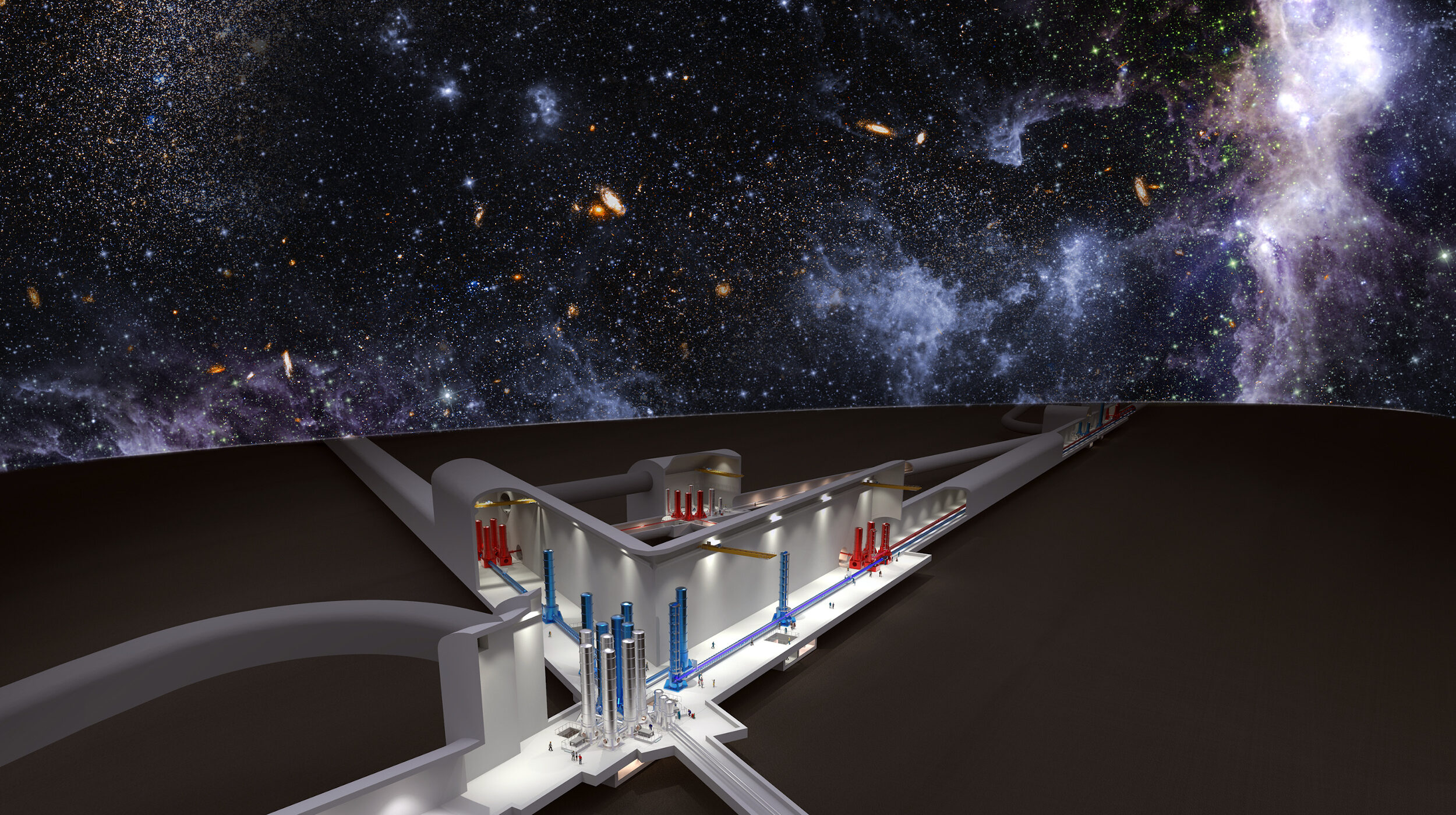 Model of the future Einstein Telescope © Marco Kraan/Nikhe
Thanks to this enhanced sensitivity, ET will observe much more distant and therefore older sources. The observatory will thus open new windows onto fundamental physics, cosmology, and the properties of black holes and neutron stars. This ambitious scientific programme will be part of a global detection network, alongside the future Cosmic Explorer.
The collaboration now brings together more than 2,000 members across 97 research units in 34 countries. The project is included in the 2021 roadmap of ESFRI (European Strategy Forum on Research Infrastructures) and is now entering a decisive phase. Decisions on the detector geometry, the site selection and the finalisation of the Technical Design Report are among the priorities of the new term.
As deputy spokesperson, Angélique Lartaux will represent the collaboration and help steer its scientific and strategic work, in coordination with the Spokesperson and the governance bodies. A specialist in instrumentation for gravitational wave detection since the mid-2010s, she has represented IJCLab's research unit within the ET collaboration since 2022. She has also been co-leading the Squeezed Light Working Group since 2025 and contributed to the detector's preliminary Technical Design Report. A member of the Early Career Support Committee since 2024, she is particularly committed to supporting the next generation of scientists.

Alongside her, Michele Maggiore (in picture) brings extensive experience in theoretical gravitational wave physics, dating back to the mid-1990s. He has co-chaired ET's Observational Science Board since 2020 and coordinated the writing of the Blue Book, the project's scientific reference document. A member of the steering committee and then the executive committee since 2019, he also founded and led the Geneva group's research unit.
For Angélique Lartaux, this new responsibility is part of a collective vision for the project. "Einstein Telescope is above all a collective scientific adventure, driven by a diverse and committed community," she says. "I will pay particular attention to ensuring that this community remains welcoming, and that early-career researchers find a space where they can contribute, grow and flourish scientifically."
Her expertise is notably rooted in the work she carries out at IJCLab on the CALVA experimental platform. Her goal: to develop a quantum technique called frequency-dependent squeezing. Quantum noise is one of the main sensitivity limits of gravitational wave detectors. It arises from vacuum fluctuations that interfere with the light used in the detector. To reduce it, squeezed vacuum with attenuated noise is injected, then reflected in a suspended Fabry-Perot cavity to tailor this reduction to each frequency range.
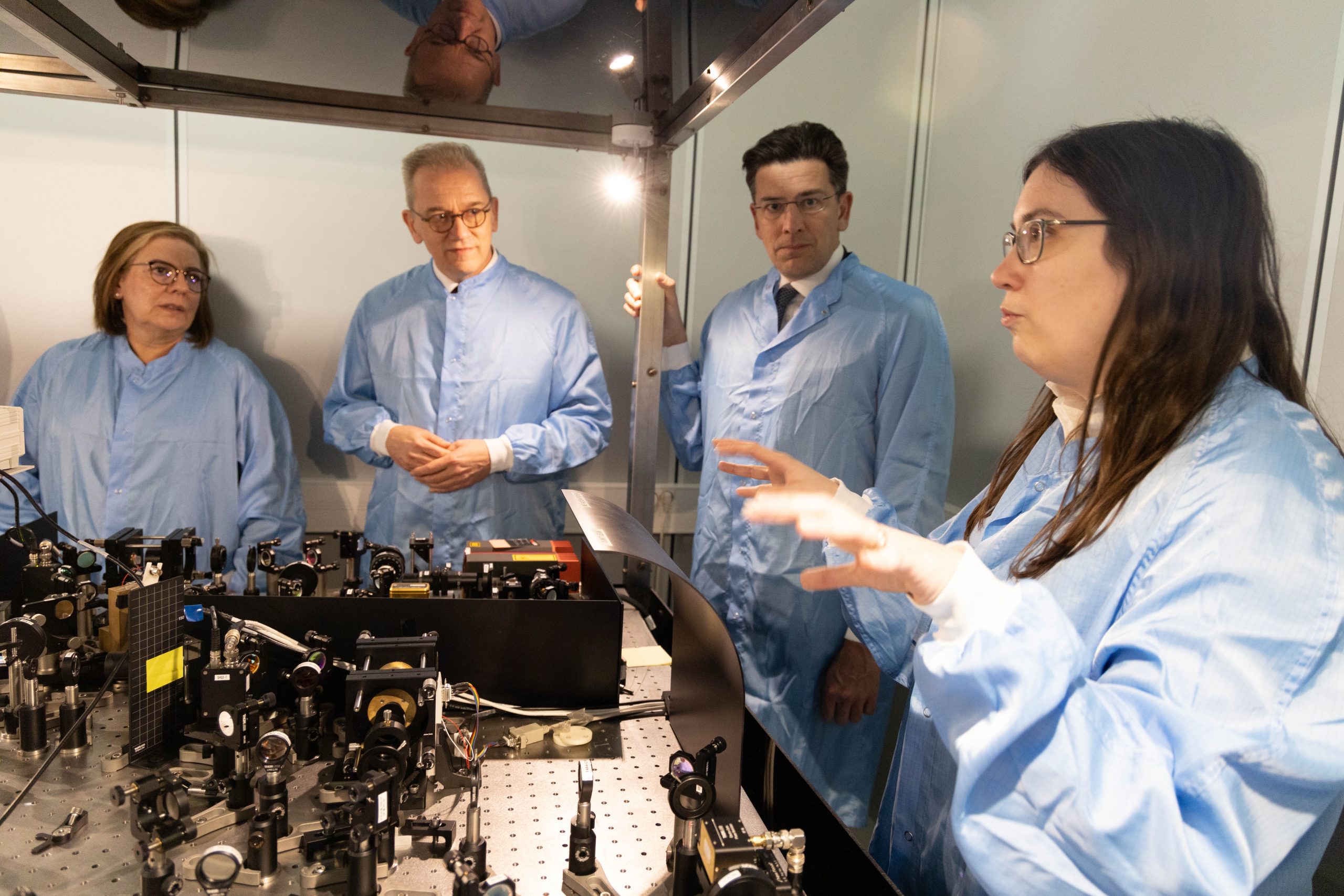 Visit of the CALVA platform by the Dutch Minister Mr Eppo Bruins, presented by Angélique Lartaux © Dominique Longieras/IJCLab
On CALVA, the teams are investigating an innovative geometry for the optical parametric oscillator, the source that produces this squeezing, as well as the impact of placing it under vacuum on quantum noise reduction performance. Another key objective is to demonstrate the use of suspended three-mirror cavities with variable finesse, on a 50-metre scale, to achieve frequency-dependent squeezing. Recognised by the Virgo collaboration, this research is supported by the ANR projects Exsqueez and QFilter. The challenge is to validate these developments for integration into the next upgrade of Virgo and, ultimately, into the design of the Einstein Telescope.