





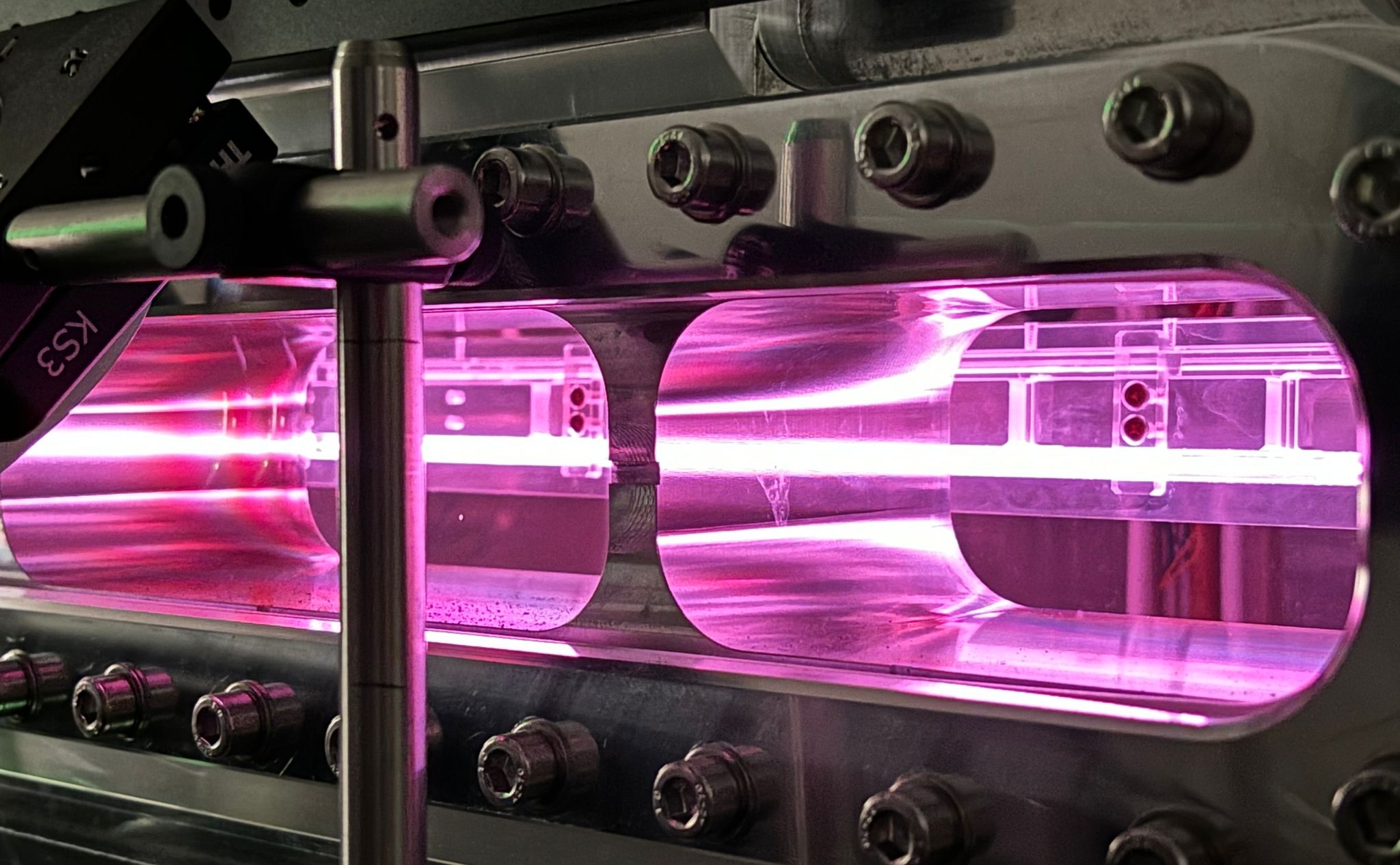
The EuPRAXIA Preparatory Phase consortium (EuPRAXIA-PP) announced the publication of a major review article in Physics of Plasmas, entitled Technical status report on plasma components and systems in the context of EuPRAXIA, which features on the journal's cover. Photo: Capillary discharge plasma prototype of an accelerating section over forty centimetres long, developed by LNF (INFN) for the EuPRAXIA site in Frascati, Italy. – Credits: @LNF-INFN A. Biagioni
This collective work, coordinated by IJCLab and DESY, brings together over thirty authors from leading European laboratories, including CNRS institutes such as the Laboratoire de physique des gaz et des plasmas (LPGP, CNRS/Université Paris-Saclay) and the Laboratoire d'Optique Appliquée (LOA, CNRS/École Polytechnique/ENSTA-Paris). The article provides a state-of-the-art review of plasma technologies essential to the development of future high-performance compact accelerators. Several teams from IJCLab contributed to this review: the Accelerators division (with ALPHA and MAVERICKs) and the Engineering division.
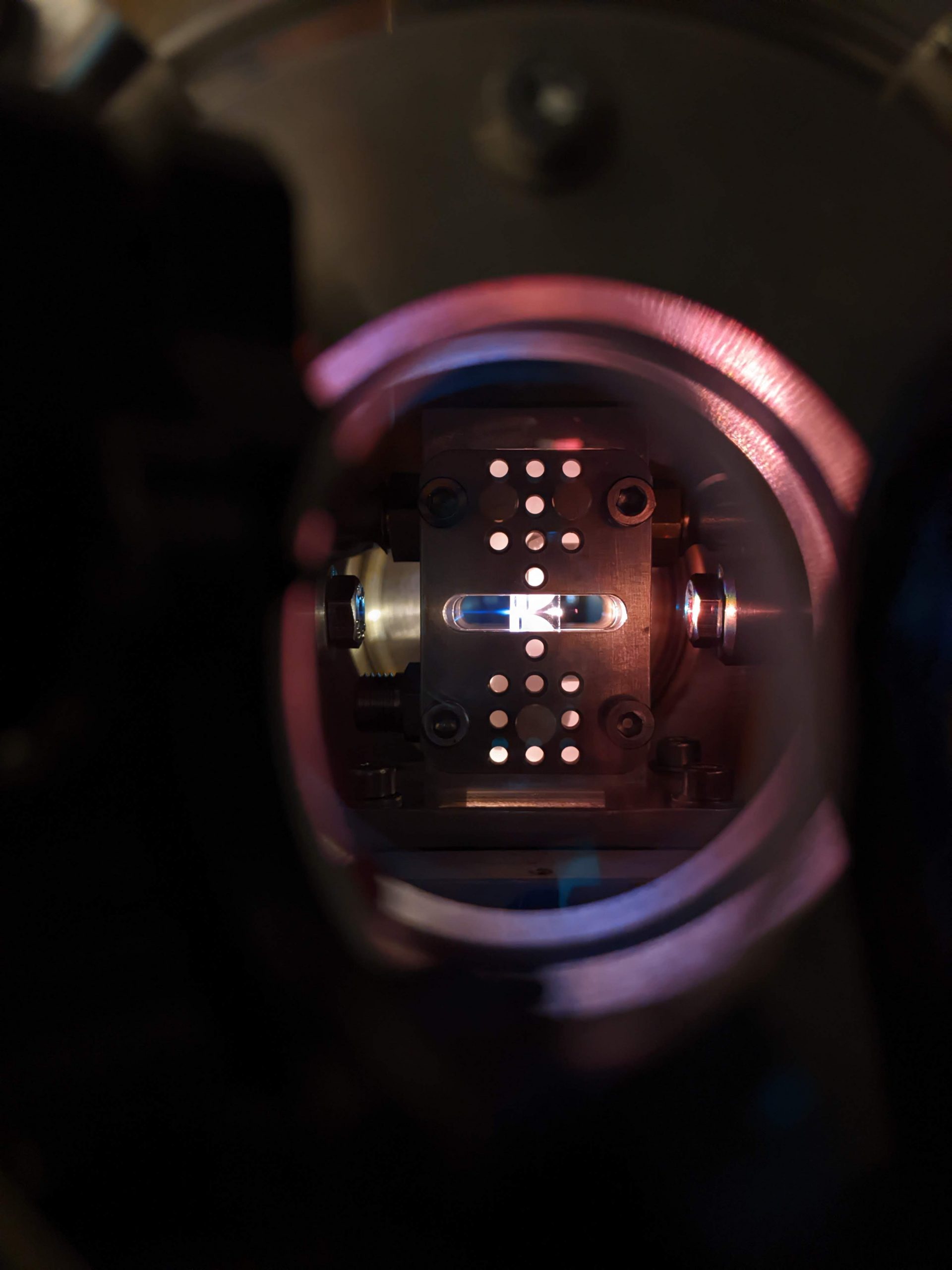
Structured gas target prototype tested at IJCLab and LOA, based on a design inspired by groups from the Gwangju Institute of Science and Technology (South Korea) and DESY (Germany).
EuPRAXIA aims to build the first European infrastructures dedicated to plasma acceleration, capable of delivering electron beams from 1 to 5 GeV with a quality comparable to current radiofrequency accelerators, but in far more compact and cost-effective facilities designed to power free-electron lasers. Achieving these ambitious goals hinges on mastering advanced plasma components.
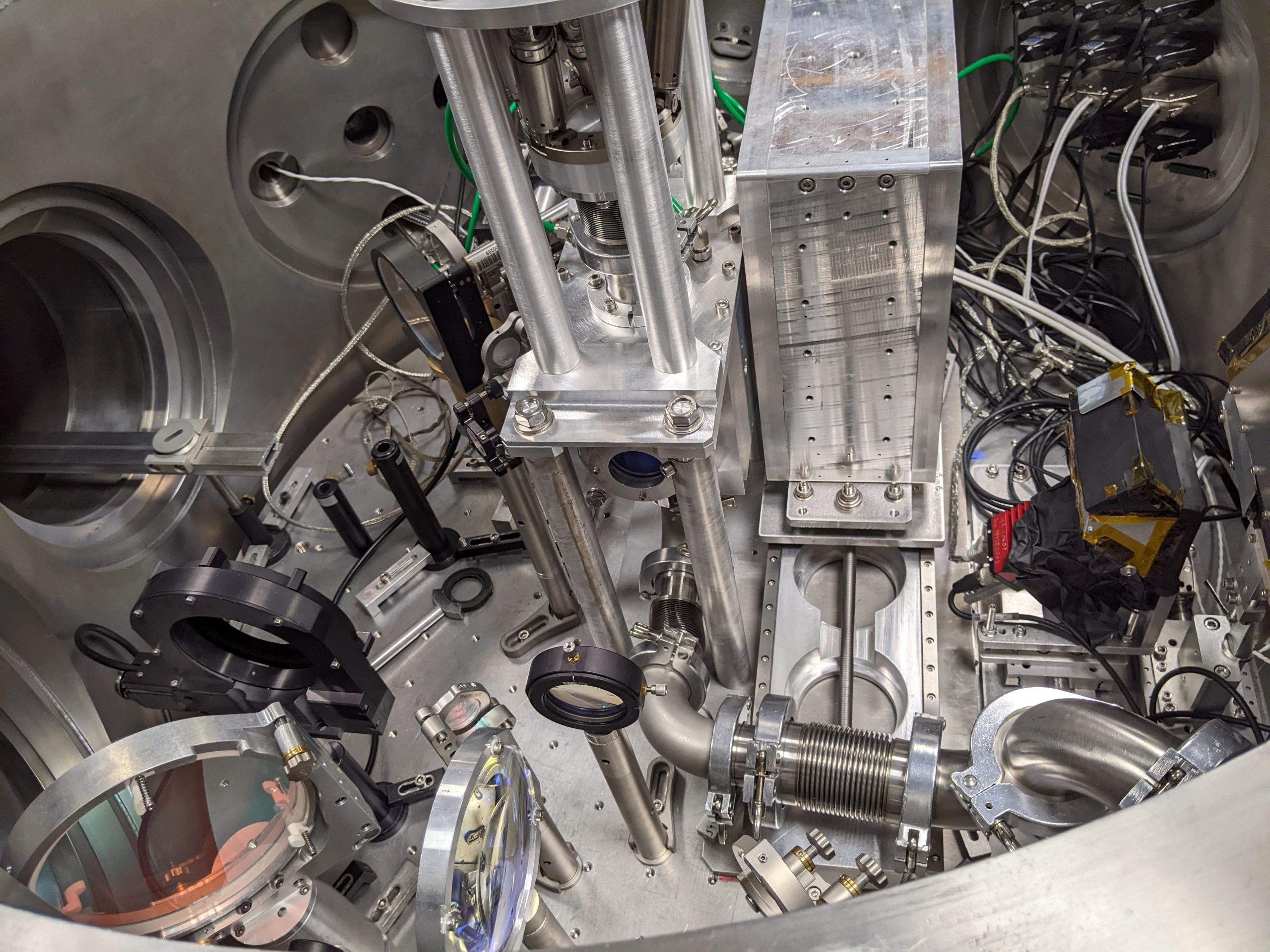
View of the differential pumping chamber of a gas cell under testing at LOA, developed by IJCLab.
The article provides an unprecedented technical synthesis of these devices, assessing their maturity, current performance and the challenges to be overcome for reliable high-repetition-rate operation. It highlights recent advances, including the generation of plasma waveguides over tens of centimetres, high-repetition-rate capillary discharge operation, and methods for precise control of gas density. These developments now make it feasible to integrate plasma components into future accelerators for scientific infrastructures.
This report constitutes a key reference for the design of the two future EuPRAXIA sites, one based on laser-plasma acceleration, the other on beam-driven plasma acceleration. It also provides a solid framework for continued developments within the European EuPRAXIA-PP preparatory project and for the international compact high-gradient accelerator community.
With this publication, EuPRAXIA confirms its leading role in the transition towards more compact, efficient accelerators accessible to a wide range of scientific, industrial and medical applications.
Learn more:
Article reference (open access): A. Biagioni et al. Phys. Plasmas 32, 110501 (2025) https://doi.org/10.1063/5.0286730
EuPRAXIA: https://www.eupraxia-facility.org/
EuPRAXIA-PP: https://www.eupraxia-pp.org/