





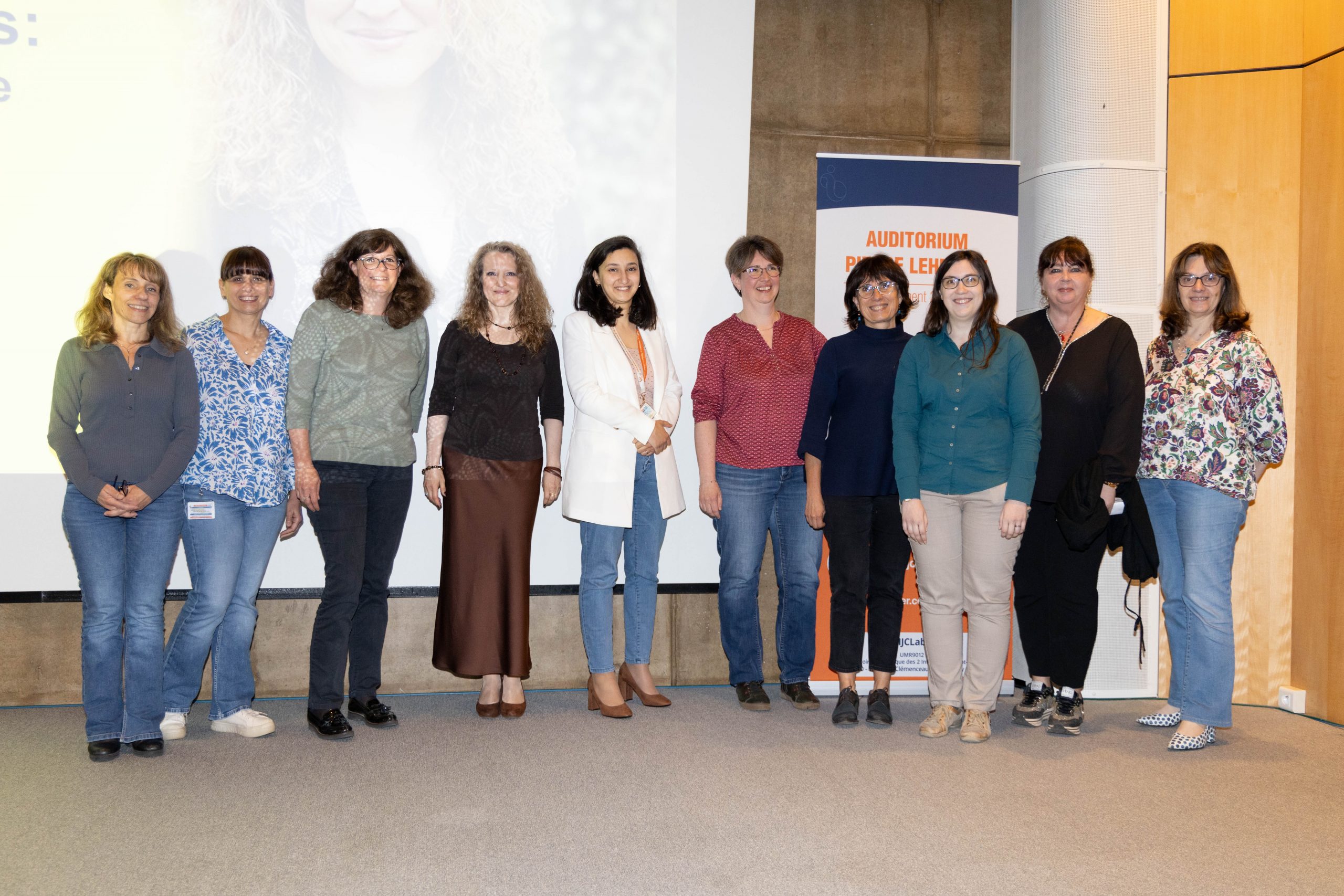
On the occasion of the International Day of Women and Girls in Science, IJCLab looks at the place of women in research and its actions to promote equality. On the cover: speakers at an afternoon dedicated to discovering scientific careers for women, organised by the laboratory.
In 1905, Mileva Marić wrote to her father: "We have just finished a very important piece of scientific work that will make my husband famous." Her husband was Albert Einstein. Their collaboration on special relativity is documented in numerous letters and testimonies. Yet history has retained only one name. On the January 15th, physicist Pauline Gagnon, a researcher at CERN, retraced this shattered destiny during a seminar at the laboratory, ahead of the International Day of Women and Girls in Science celebrated each year on February 11th.
A concerning national landscape
The case of Mileva Marić belongs to the past. The obstacles women face in science, however, persist. In France, women represent 30% of researchers, but this proportion varies considerably across fields. In physics, they remain in the minority at all career levels.
At each stage of the journey, from school to senior positions, the proportion of women decreases. This is known as the "leaky pipeline". A Senate report published in October 2025 identified several factors: the weight of stereotypes from childhood, reduced access to professional networks, and evaluation criteria that may disadvantage certain life paths.
This under-representation is not merely a question of fairness. It affects research as a whole. Diverse teams bring complementary perspectives, challenge hypotheses differently, and explore varied avenues. Whether exploring the infinitely small or the infinitely large, the complexity of today's challenges requires mobilising all talents.
Encouraging progress at IJCLab
At the laboratory, indicators are moving in the right direction. In the scientific divisions, the share of women has risen from 24.6% in 2023 to 29.7% in 2025, an increase of 5 percentage points in two years. Among doctoral and postdoctoral researchers, women now represent 31.5% of the workforce.
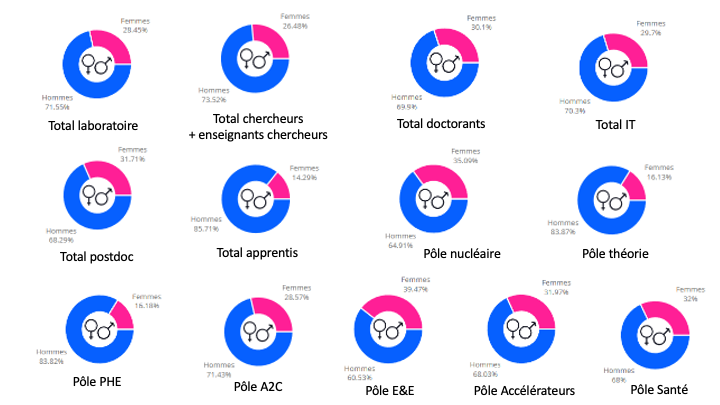
A detailed overview of the gender balance in the laboratory's different departments.
These results vary by sector. Women make up 63% of administrative staff but only 17% of the Engineering division and 11% of teams on technical platforms. This imbalance is found in most physics laboratories in France.
Several recent appointments nonetheless reflect a shift. Giulia Hull has taken over as head of the Engineering division, succeeding Valérie Chambert. Aurélie Gentils now leads the Energy and Environment division. At European level, Araceli Lopez-Martens, research director in nuclear physics and CNRS Silver Medal laureate 2023, is this year taking up the presidency of the Nuclear Physics Division of the European Physical Society.
Taking action
Beyond these developments, the laboratory is working to accelerate progress. IJCLab organises afternoons dedicated to discovering scientific careers for women, aimed at secondary school students. In 2023, Karim Noui, a researcher in theoretical physics, led this event. In 2024, Véronique Puill, recipient of the CNRS Crystal and the Suzanne Bella Srodogora Prize from the CNRS Foundation, brought together eight women from the laboratory to share their experiences. Engineers, researchers, department heads: these presentations showcased the diversity of professions in a research laboratory and the accessibility of these careers, often built on non-linear trajectories.
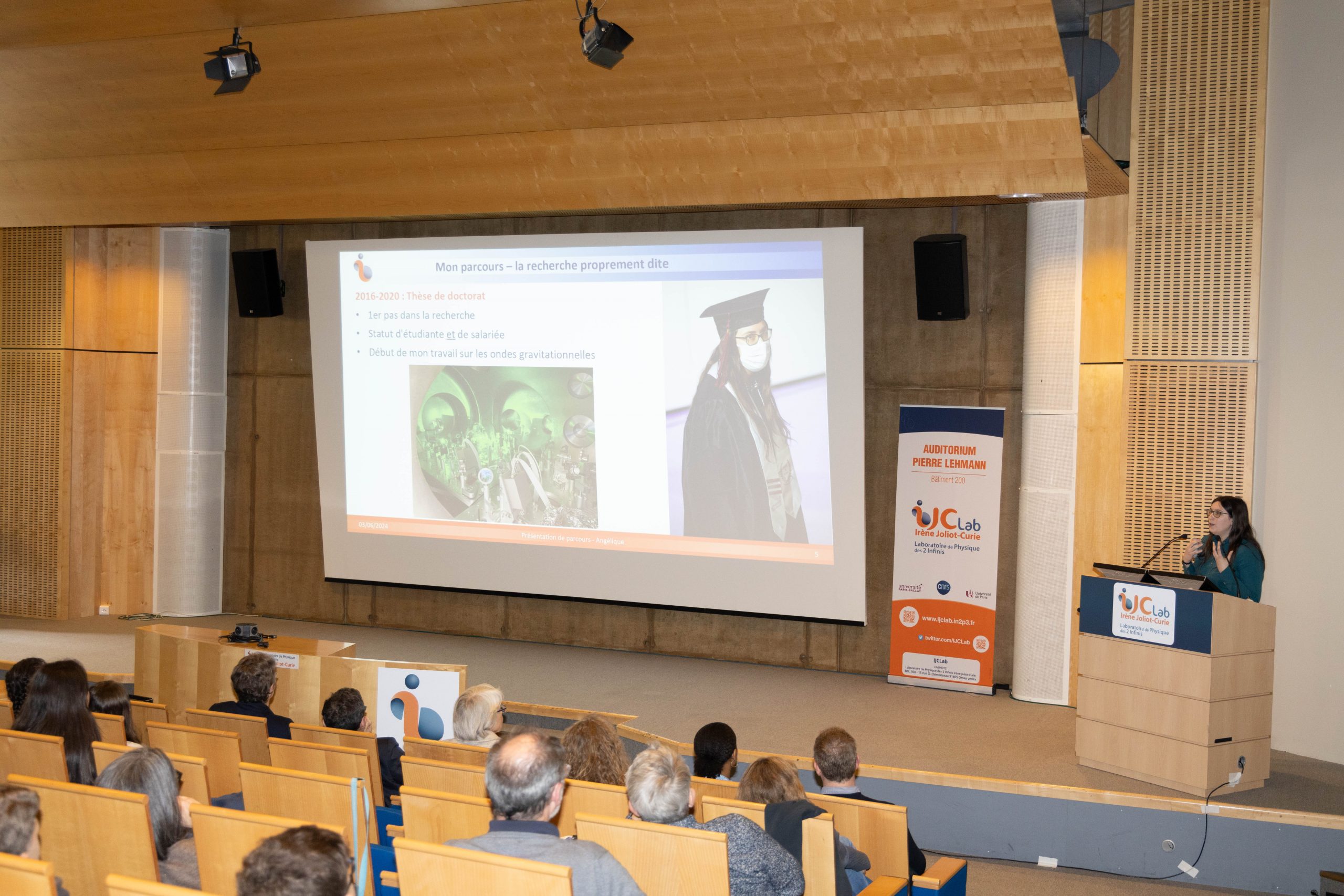
Angélique Lartaux, research director at IJCLab, presents her career path.
Regular monitoring of gender parity indicators is carried out with the human resources department. A charter of good practice is being drafted with the Equality and Parity network of CNRS Nuclear and Particle Physics. IJCLab also promotes events organised by Université Paris-Saclay, CNRS and the European GENERA network.
More than a century after Mileva Marić, the challenge remains to build a science where no talent fades into the shadows. The progress observed at the laboratory shows that things are moving forward. It also serves as a reminder of the journey that still lies ahead.
Learn more:
- CNRS - Féminiser les sciences : comment réparer le « tuyau percé »
- MESR-DGESIP/DGRI-SIES, État de l'Enseignement supérieur et de la Recherche en France n°18, fiche 37, données 2022. MENESR-DGRI-SITTAR - « La parité dans la recherche »
- XX=XY, féminiser les sciences, dynamiser la société » - Rapport d'information n° 9 (2025-2026), tome I
- Séminaire de Pauline Gagnon : Le destin tragique de Mileva Marić Einstein
For laboratory members: The EDI (Equality-Diversity-Inclusion) mission works to promote equality, diversity and inclusion at the laboratory and within its institutional environment. You can find all information about their activities on the laboratory intranet.