






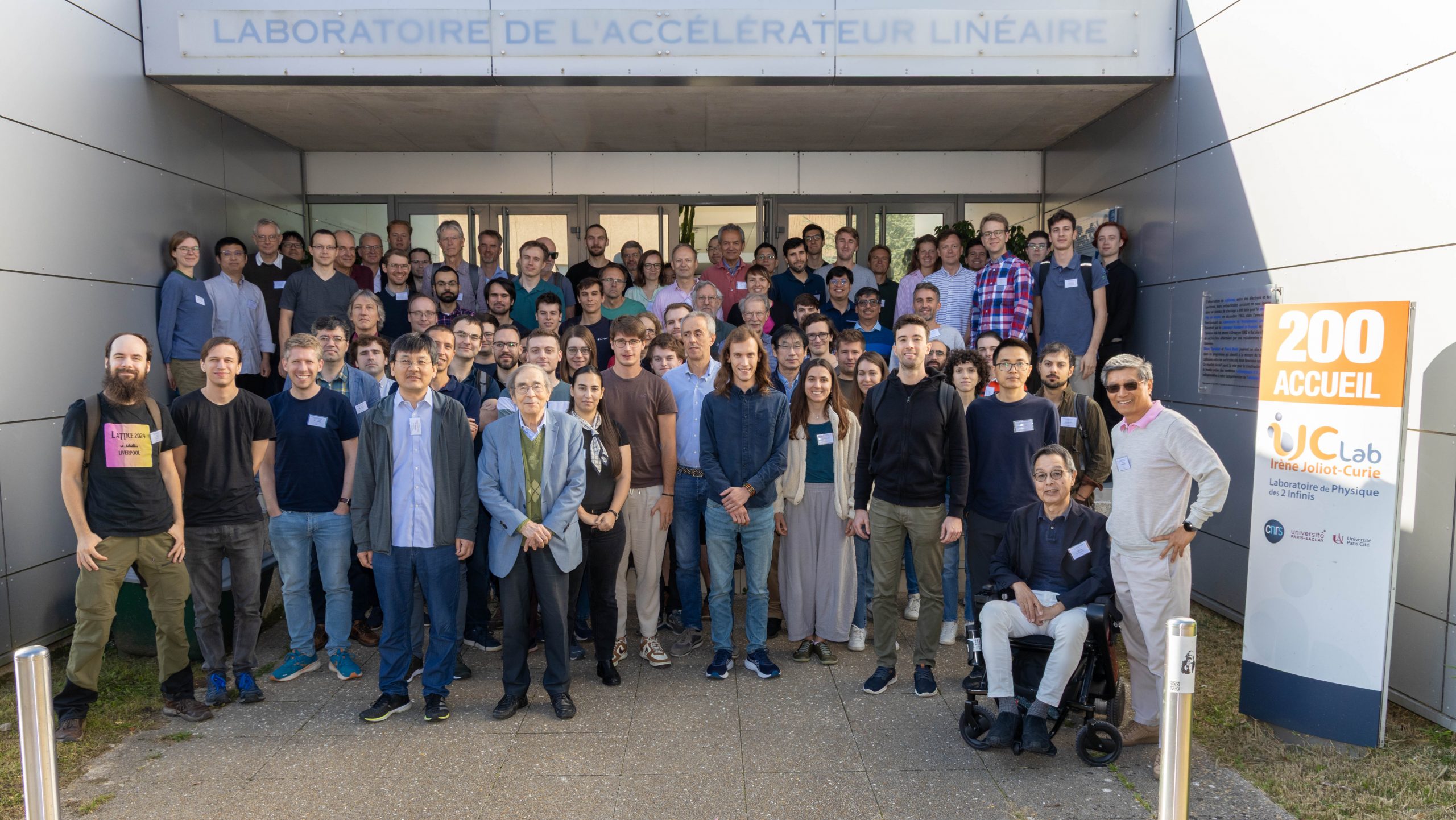
IJCLab successfully hosted the 8th plenary workshop of the Muon g-2 Theory Initiative from September 8-12, 2025, co-organized with LPNHE and CPT from Aix-Marseille University. Over 100 physicists from around the world gathered to converge theory and experiment on one of the most precise measurements in particle physics.
Understanding and reconciling divergent results
The anomalous magnetic moment of the muon has been subject to extremely precise measurements and calculations for over 20 years. Currently, different theoretical and experimental approaches yield results that don't fully converge, creating a complex situation that requires coordinated effort from the international community to resolve.
 Fermilab results published in juin 2025 by the Muon g-2 group
The workshop was marked by the Fermilab muon g-2 experiment showing their final result on the direct measurement. A highlight was the announcement of a new BaBar measurement of the two-pion cross section in e+e− annihilation, which confirms their 2009 result. The 2009-2025 combination provides the most precise measurement in this channel, which is the primary input for the data-based prediction of the hadronic vacuum polarization (HVP) contribution. This new BABAR measurement results in a Standard Model prediction for the muon g-2 that is in tension with the direct measurement by the Fermilab collaboration.

An overview of the predictions based on e+e- and tau data from different experiments and lattice-based predictions compared to the direct measurement dominated by the Fermilab muon g-2 experiment.
La combinaison 2009-2025 fournit la mesure la plus précise dans ce canal, ingrédient primaire pour la prédiction basée sur les données de la contribution de polarisation hadronique du vide (HVP). Cette nouvelle mesure BaBar aboutit à une prédiction du Modèle Standard pour le muon g-2 qui reste en tension avec la mesure directe de Fermilab.
A mobilization for ultimate precision
Facing the complexity of the problem, the community is organizing methodically. The BESIII, Belle II, CMD3, KLOE and SND experiments are performing new measurements, with timescales varying between 1 and 2 years. These new measurements are needed to clarify the current discrepancy among the different measurements in the two-pion channel.
Alternative approaches are also being explored: data-based HVP prediction using tau data, with a new measurement from Belle II expected in the near future, and isospin breaking corrections needed to use tau data, discussed from different angles (data-driven, theoretical models and lattice calculations). Progress on higher order event Monte Carlo generators was reported, and different data-based evaluation methods for HVP were discussed. Results and progress from several lattice groups were reported both for HVP and light-by-light calculations, the latter now being in good control.

Aida Ek-Khadra announces the publication of the 2025 White Paper on the evening of the group dinner at the Musée d'Orsay.
As Aida El-Khadra, chair of the Theory Initiative, noted, it is remarkable to see the progress in the area of g-2 only three months after the finalization of the 2025 White Paper.
IJCLab at the heart of solving the puzzle
Hosting this workshop at IJCLab marks the international recognition of French expertise in this precision field. Michel Davier and Zhiqing Zhang from IJCLab, who organized the event, created with their colleagues from LPNHE and CPT optimal conditions for these high-level scientific exchanges.
There is now agreement on the fact that particular attention should be given to the uncertainties involved in the estimate of experimental systematic uncertainties and their correlations as function of energy, a point repeatedly stated by the DHMZ Orsay-Paris group. The Mainz group also presented new pion transition form factor results in the space-like (BESIII) and time-like (A2/MAMI) sectors.
Toward a definitive answer
The workshop established an ambitious roadmap: several dedicated task forces/working groups will be formed to discuss new measurement results and understand remaining discrepancies. The Theory Initiative is preparing an open letter to support the independent muon g-2 project at J-PARC and is aiming for a third version of the White Paper in 2-3 years.
This meeting marks a crucial step in understanding the muon's anomalous magnetic moment. The coordinated effort will determine whether the observed discrepancy constitutes a real deviation from the Standard Model, potentially opening the door to physics beyond our current understanding. Whatever the outcome, IJCLab's expertise and commitment will remain decisive in this scientific adventure, with the next meeting already set for the 9th workshop likely in 2026 in the US.