





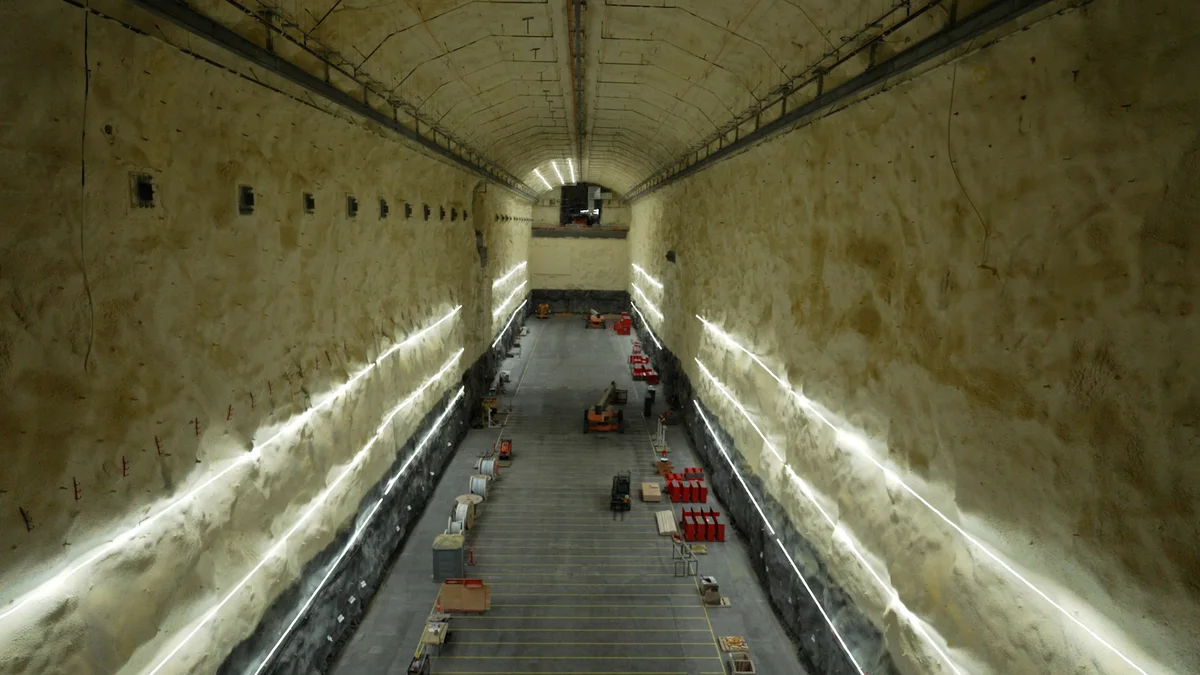
The first cryostat elements have arrived underground at SURF. At CERN, the ProtoDUNE-VD prototype is delivering its first data, with a significant contribution from IJCLab. Photo: 605 Media & Entertainment/Clark Young
The Deep Underground Neutrino Experiment (DUNE) has reached a new milestone in the construction of its far detectors. CNRS Nuclear and Particle Physics laboratories are taking part in this international project, including IJCLab. The first steel beams of the cryostat have been transported 1,500 metres underground, into the new cavern at the Sanford Underground Research Facility (SURF) in the United States.
Inside DUNE's underground cavern
This vast cavern, measuring 150 metres long, 20 metres wide and 25 metres high, is entering a new operational phase. It will house DUNE's future vertical drift far detector. Its construction required several years of excavation and preparation. Members of the DUNE collaboration were able to visit it in May 2026, during their meeting in Rapid City.
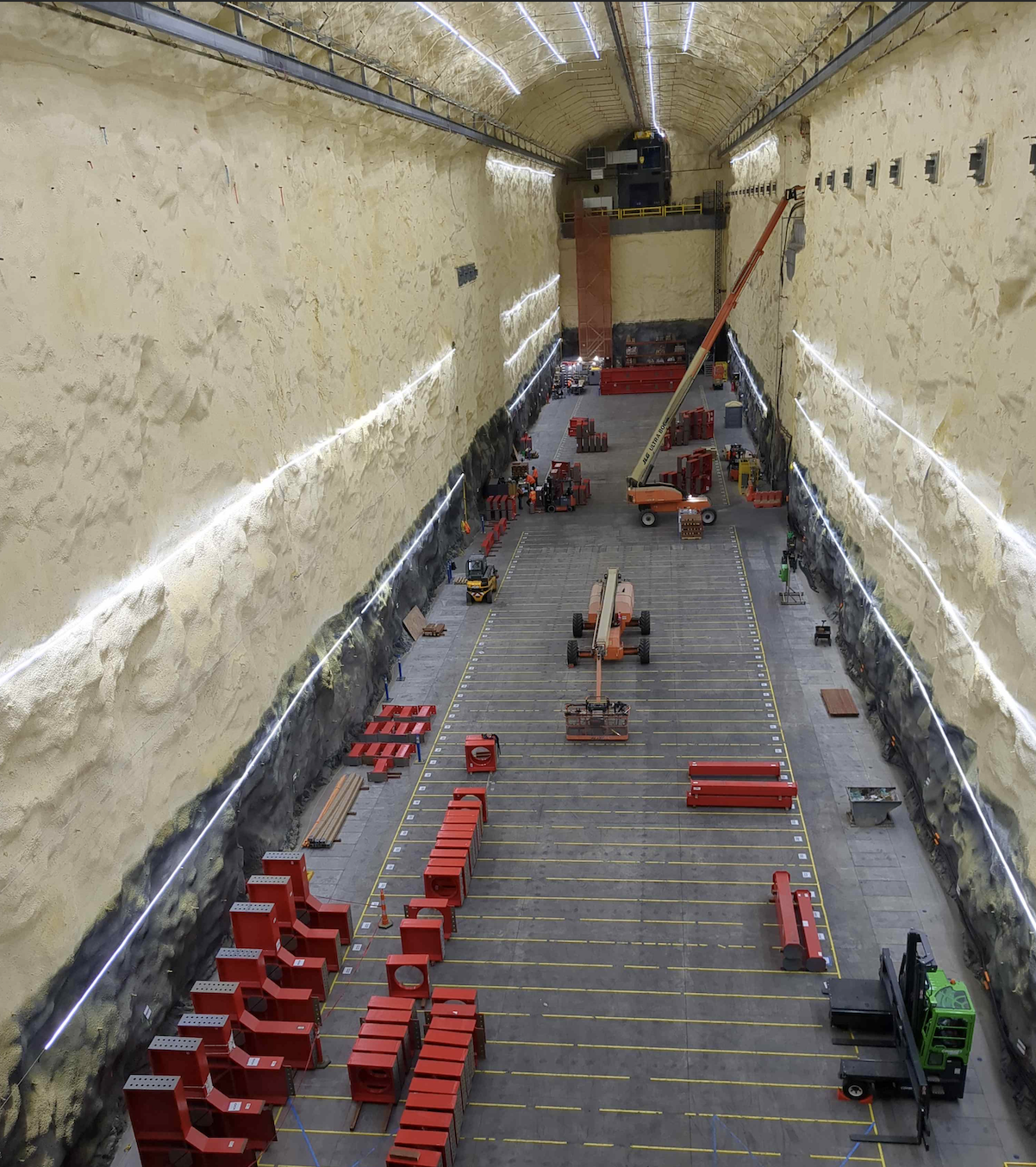
View of the cavern (approximately 150 m x 20 m x 25 m) that will house the vertical drift far detector of the DUNE experiment, 1,500 m underground at SURF, with the first cryostat elements shown in red.
This detector will observe neutrinos produced 1,300 kilometres away at the Fermilab complex, using the PIP II accelerator (Proton Improvement Plan II), to which IJCLab also contributes, as the source. A 'near' detector will complete the measurement. Together, the two sites will reveal how neutrinos oscillate along their path.
Why bury the detector so deep? At the surface, cosmic rays constantly bombard the atmosphere. They produce muons and particle showers. These background signals would mask the rare neutrino interactions. The 1,500 metres of rock therefore form a natural shield. They absorb cosmic particles while neutrinos pass through the rock almost unimpeded. The detector thus benefits from the environment needed for precision measurements.
ProtoDUNE-VD, a key prototype at CERN
Meanwhile, CNRS Nuclear and Particle Physics teams are actively involved in analysing DUNE data. This work draws in particular on the far detector prototypes. The vertical drift prototype, ProtoDUNE-VD, has been collecting data since September 2025 at CERN's neutrino platform.
ProtoDUNE-VD comprises two active volumes of 34 cubic metres each. Its dimensions reach 3 metres by 3.35 metres by 3.34 metres. It is thus one of the largest liquid argon time projection chambers ever built. The IJCLab team contributed significantly to the design of the detector's cathode. This cathode is held at a high voltage of -150 kilovolts.
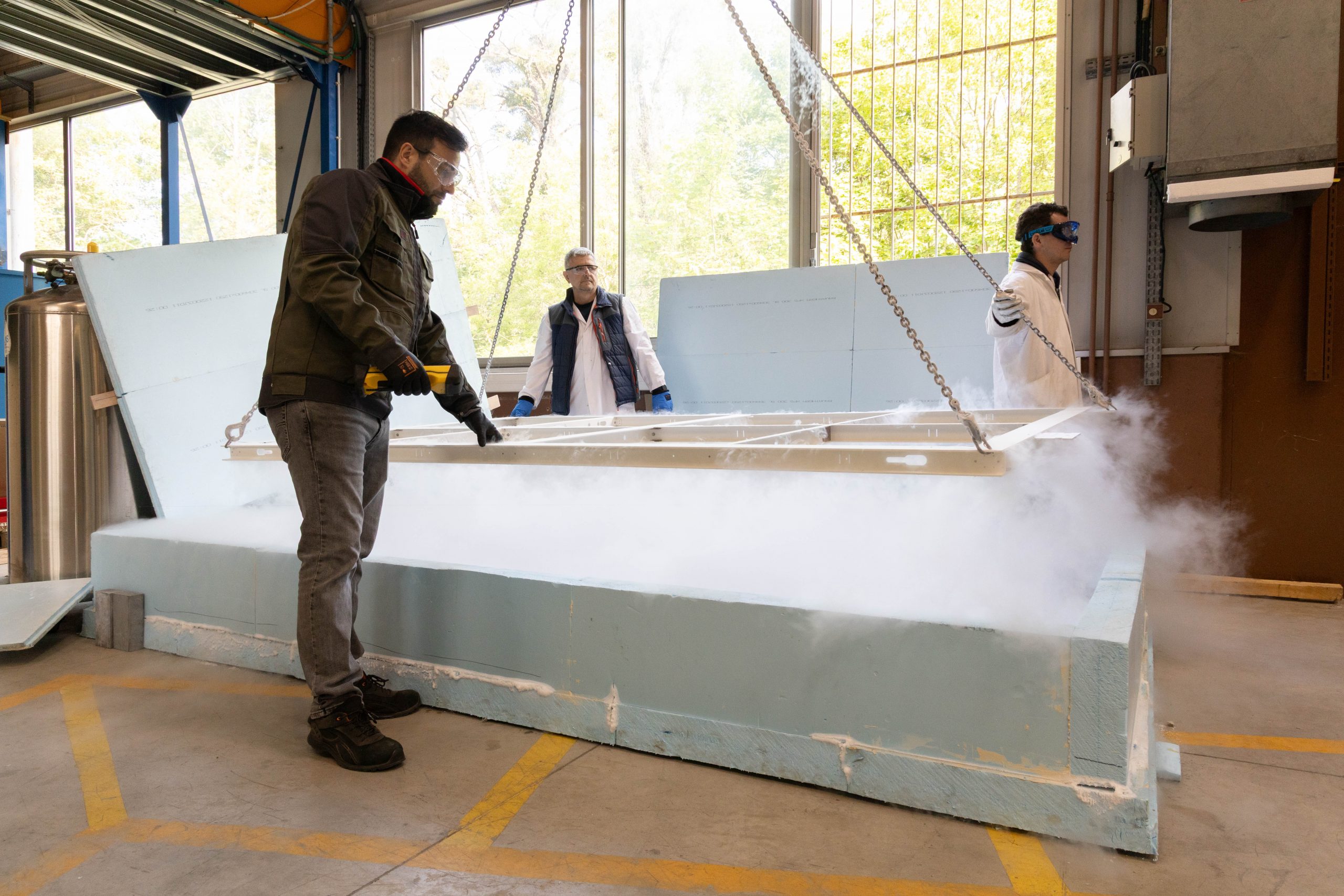
The fibreglass cathode will be immersed in liquid argon (-200°C) for several years. At the end of fabrication, each frame making up the cathode undergoes a thermal shock test by immersion in a liquid nitrogen bath, to ensure the assembly holds up correctly where elements are bonded together, following a quality assurance procedure required by the project. Bending stiffness is verified by checking deformation under load before and after immersion. 100% of the frames tested to date have been validated. Photo: Dominique Longieras/IJCLab
IJCLab also designed its suspension system, which establishes a uniform electric field of 450 volts per centimetre across the full drift distance of 3.34 metres.
A particle beam to test the detector
After its subsystems were ramped up in summer 2025, the detector was exposed to a beam of charged particles. This beam came from CERN's SPS, over a period of around ten days. The experiment made it possible to collect hundreds of thousands of particles, including electrons, pions, kaons and protons. Their energy ranged between 0.5 and 8 GeV per c.
This energy range overlaps with that of the neutrino beam produced by Fermilab's LBNF. It is therefore particularly useful for testing the detector's performance. Several event topologies could thus be studied: electromagnetic and hadronic showers, tracks, inelastic interactions and particle decays.
Feeding neutrino research
The IJCLab team is particularly involved in the reconstruction of this beam data. It is also working on atmospheric muons, used to calibrate the detector at low energy.
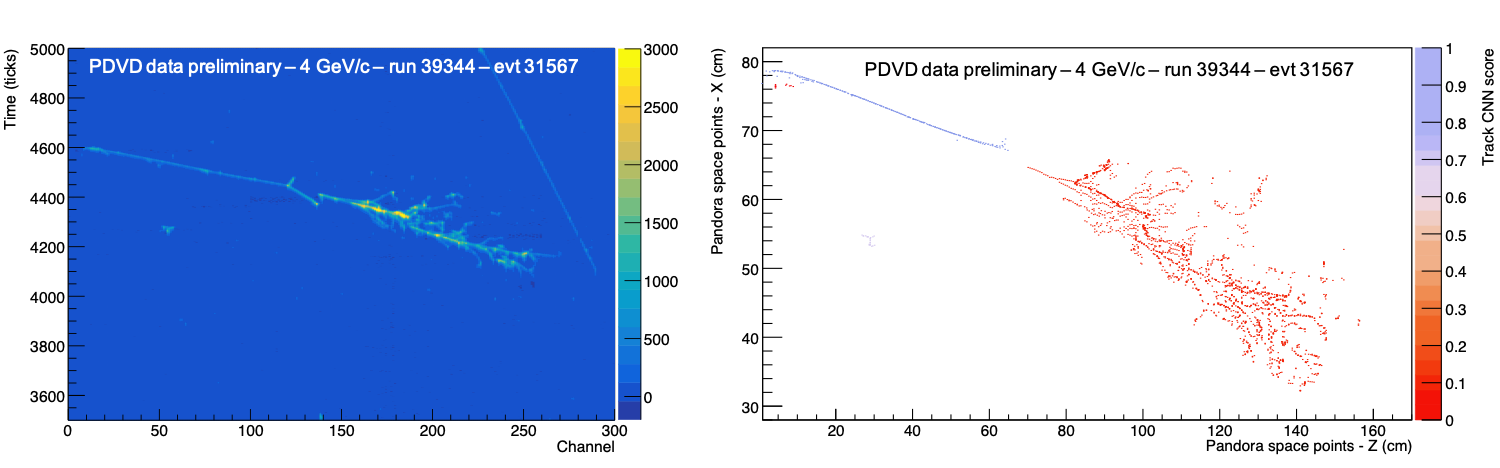
Left, raw signals from a potential 4 GeV/c pion, with the decay of a neutral pion into a pair of photons in the final state. Right, event reconstruction with separation of tracks and electromagnetic showers using a convolutional neural network (CNN).
The ongoing analyses will provide essential information for DUNE's research programmes. This work relates to neutrino flavour oscillations and also sheds light on the study of solar and supernova neutrinos.
Find out more :
- See a recent review: https://indico.in2p3.fr/event/38819/contributions/171539/
- For more information on IN2P3's contributions to DUNE, see the recent briefing to the IN2P3 scientific council: https://www.in2p3.cnrs.fr/fr/les-sessions-du-cs-in2p3-devaluation-de-projets