







David Verney, director of the nuclear division at IJCLab, has published a landmark review in the European Physical Journal A retracing the evolution of the nuclear shape concept. This historical synthesis reveals how an initially controversial idea has become fundamental to understanding nuclear matter at all energy scales.
Cover image: an artist's view of the nuclear translucency phenomenon by Luc Petizon. The shape of the nucleus appears to an observer as spatially averaged over all possible orientations of the symmetry axis, giving the appearance of a sphere with blurred contours.
What is nuclear shape?
The concept of nuclear shape refers to the deviation of the spatial distribution of nuclear matter from a perfect sphere. This shape, characterized mainly by the deformation parameters β (elongation) and γ (asymmetry), is never directly observable: it exists in an intrinsic reference frame linked to the nucleus, experimentally inaccessible. Paradoxically, this "invisible" concept allows for correlating and unifying a multitude of observables: quadrupole moments, electromagnetic transition probabilities, rotational spectra, and now collision patterns at ultra-high energy. It is this extraordinary unifying capacity that makes the concept of nuclear shape one of the pillars of modern nuclear physics.
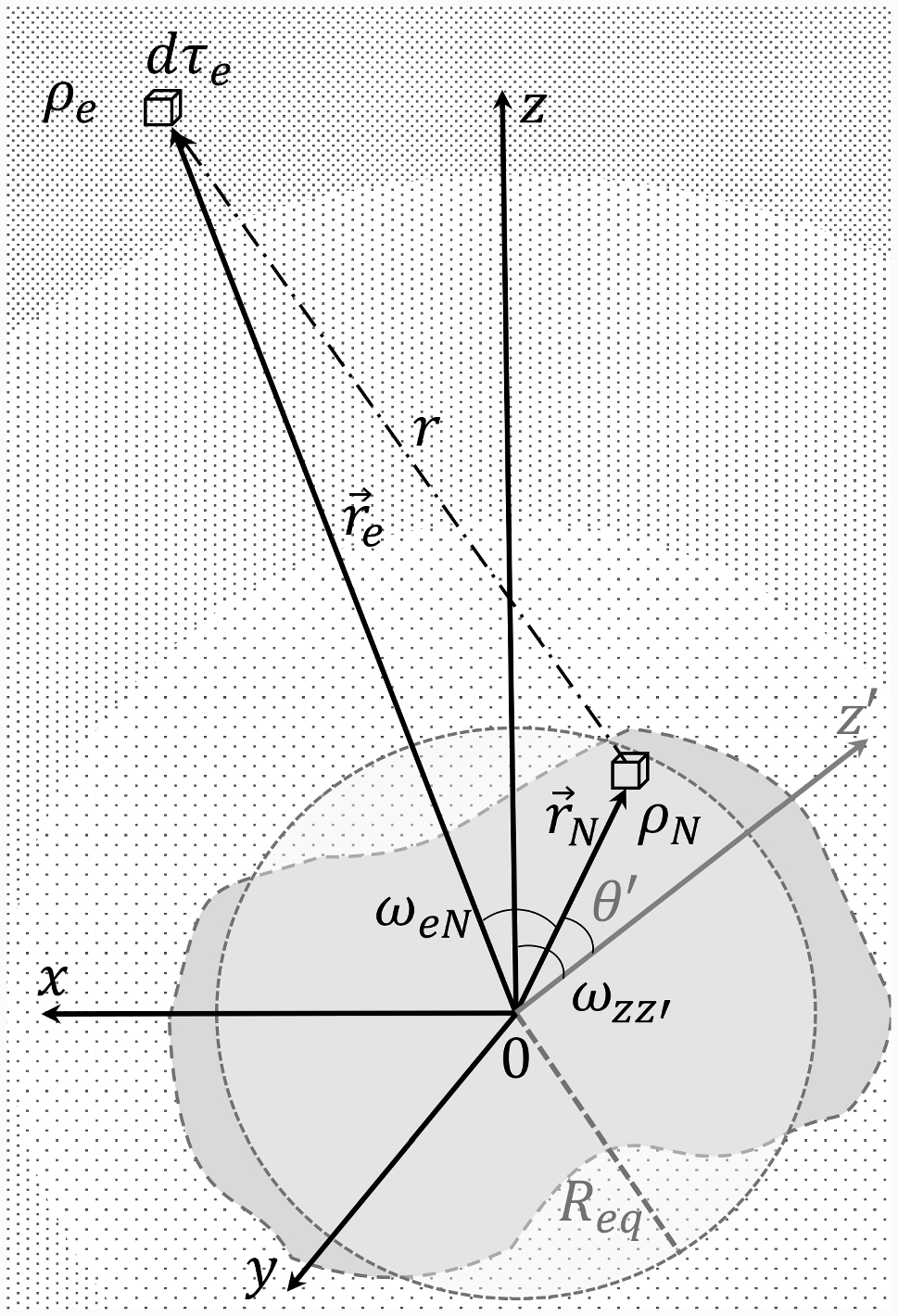 Nuclear charge distribution in the electron cloud. The laboratory reference frame is defined by the axes (x, y, z). r represents the distance between a nuclear volume element (r→n) and an electronic volume element (r→e).
The beginnings of a conceptual revolution (1930-1950)
The story begins in 1935 at the Potsdam Observatory. Schüler and Schmidt, studying the hyperfine spectra of europium isotopes, observe anomalies inexplicable with the then universally accepted image of a spherical nucleus. Their article, entitled "On deviations of the atomic nucleus from spherical symmetry", marks the birth of the concept of nuclear deformation. Paradoxically, this fundamental discovery remained marginalized for nearly fifteen years, victim of an epistemological bias: these effects were observed in odd nuclei and therefore attributed to the effect of a single proton.
The dominant model of the time, the liquid drop model developed by von Weizsäcker and popularized by the discovery of fission in 1938, left no room for static deformation. In this theoretical framework, the nucleus could only deform transiently, during surface oscillations or on the path leading to fission. This vision seemed all the more solid as it remarkably explained binding energies and the fission mechanism discovered by Meitner and Frisch.

© Aung Soe Min
The Columbia turning point: reconciling the irreconcilable (1949-1951)
The real turning point came in 1949 at Columbia University. James Rainwater, attending a colloquium by Charles Townes on quadrupole moments, had a brilliant intuition. The data show a striking correlation: quadrupole moments vanish at magic numbers and reach maxima between them. But above all, some values exceed by 35 times the predictions of Maria Goeppert-Mayer's shell model, otherwise triumphant.
 |
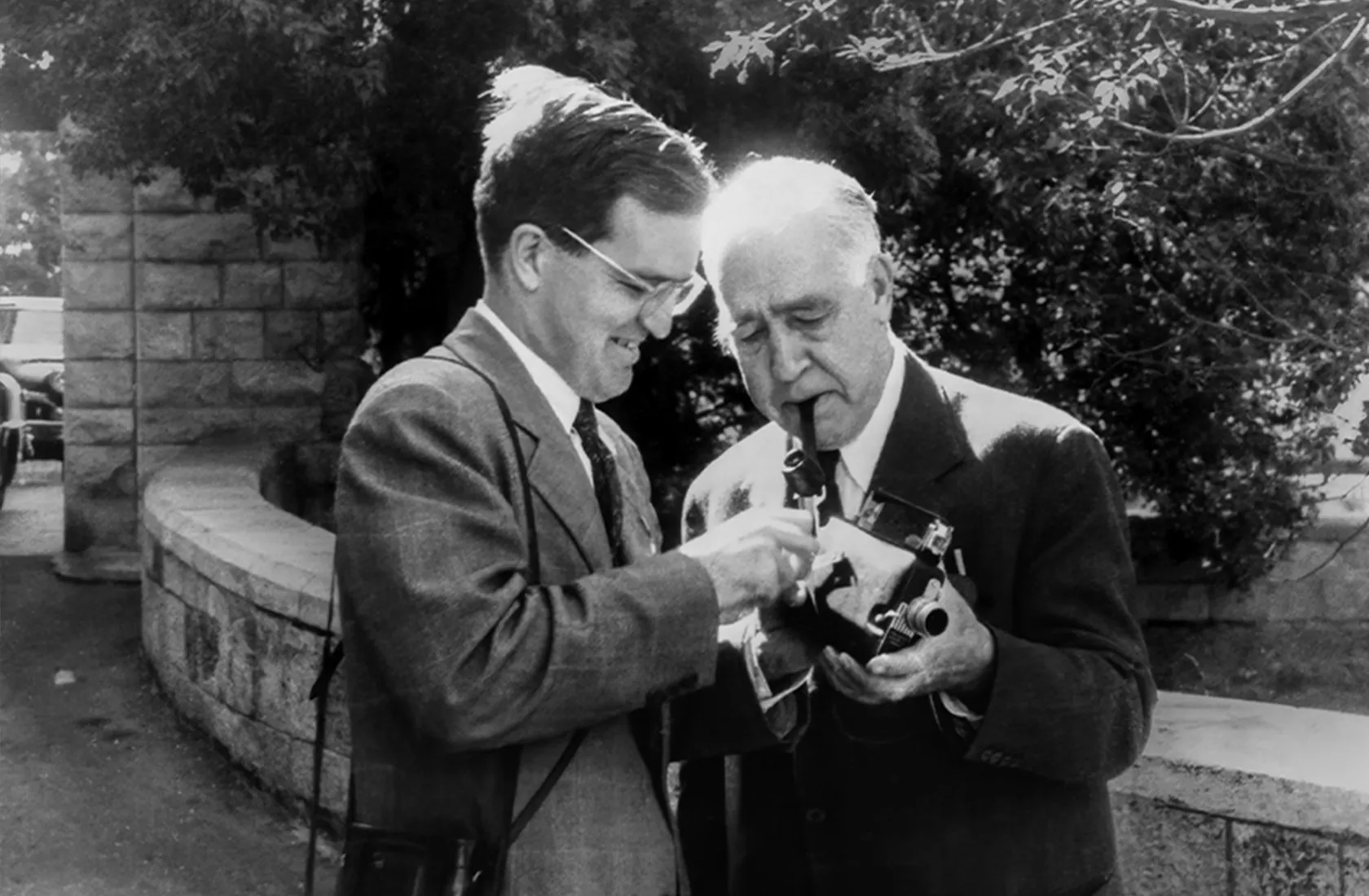 |
James Rainwater in 1975, Aage Bohr and his father © AIP Emilio Segrè Visual Archives
Rainwater then proposes a revolutionary mechanism based on the kinetic energy of nucleons: in a spheroidal potential, equatorial orbits have different kinetic energy from polar orbits, creating a force that deforms the nucleus. This idea, developed with Aage Bohr (then a post-doctoral visitor sharing his office), leads to the unified model that reconciles two apparently antagonistic visions: the shell structure of individual nucleons and the collective liquid drop behavior.
This conceptual synthesis opens two major research axes around the intrinsic quadrupole moment Q₀, a quantity that quantifies the permanent deformation of the nucleus in its own reference frame.
First axis: indirect observation of deformation
Even-even nuclei in their ground state present a quantum paradox: although possessing a non-zero intrinsic quadrupole moment Q₀ (thus a deformed shape), their zero total spin makes this deformation not directly observable. The deformation manifests only during electromagnetic transitions to the first excited 2⁺ states. Coulomb excitation then becomes the preferred method for probing this hidden deformation: the intensity of the 0⁺ → 2⁺ transition is directly proportional to the square of the intrinsic quadrupole moment.
Second axis: rotational bands
A deformed nucleus can generate angular momentum by collective rotation. This rotation produces characteristic state sequences called rotational bands, where energies follow the law E ∝ I(I+1), I being the total spin. These bands constitute a direct spectroscopic signature of nuclear deformation.
Coulomb excitation experiments conducted from 1956 confirm these two predictions, thus validating the unified model and establishing the physical reality of static nuclear deformation.
The golden age: from superdeformation to shape coexistences (1960-2000)
The following decades see the flourishing of the concept with a succession of spectacular discoveries. In 1961, a team from Dubna discovers fission isomers, metastable states with lifetimes 10²⁰ times shorter than those observed until then. Strutinsky demonstrates that these states correspond to a second minimum in the fission barrier, stabilized by shell effects at very large deformation (axis ratio c/a ≈ 2). This "superdeformation" at zero spin prefigures the discovery, 25 years later, of high-spin superdeformation in ¹⁵²Dy, where rotation stabilizes extreme shapes.
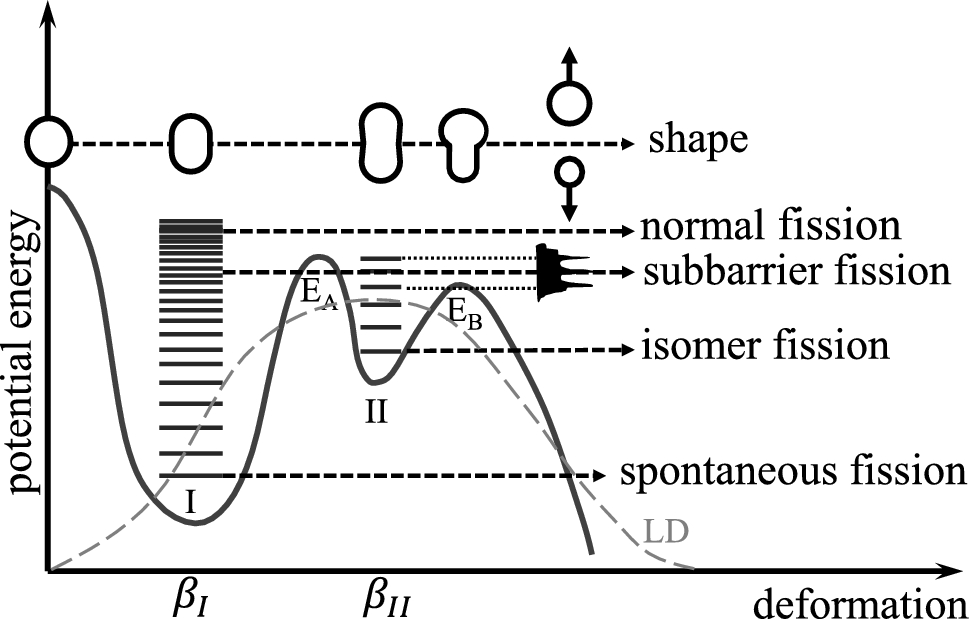
Double-humped fission barrier and shape isomer. The figure illustrates two phenomena: isomeric fission and sub-threshold fission. The gray curve schematically shows the barrier according to the pure liquid drop model.
Simultaneously, technological developments allow exploration of uncharted territories. Isotope separation on-line (ISOL) techniques, developed notably at CERN with important contributions from Orsay teams (laboratories before the IJCLab merger), reveal unexpected phenomena. Measurements on neutron-deficient mercury isotopes show spectacular oscillations of the charge radius between even and odd isotopes, a signature of coexistence between oblate and prolate shapes. Even more surprisingly, approaching the magic number N=20 in the sodium chain is accompanied by an increase in the mean square charge radius, challenging the universality of sphericity at shell closures.
These observations lead to a paradigm shift in the 1990s. Deformation and the very concept of nuclear shape is no longer restricted to certain nuclei with specific properties but as a universal phenomenon. According to Heyde and Wood's formulation, all nuclei possess several configurations of different shapes. It is the interaction between correlations and shell structure that favors one or another depending on conditions.
The high-energy surprise: when the extreme meets the fundamental (2020-)
The most recent and perhaps most surprising episode of this story begins in 2020. Giuliano Giacalone and his collaborators, analyzing ultra-relativistic heavy-ion collision data from RHIC, make an unexpected discovery: to correctly reproduce spatial correlations in quark-gluon plasma formation, one must account for the intrinsic shape of colliding nuclei.

The Solenoidal Tracker at RHIC (STAR) is a detector specialized in tracking the thousands of particles produced in each ion collision at RHIC. © Kevin Coughlin/Brookhaven National Laboratory
This observation is remarkable on several levels. First, it occurs in an energy regime where characteristic collision times (10⁻²⁴ to 10⁻²⁶ seconds) are infinitely shorter than nuclear collective motion times (10⁻²¹ seconds). Second, at these extreme energies, one would expect only the internal degrees of freedom of nucleons (quarks and gluons) to be relevant. Yet, the deduced deformation values, notably β ≈ 0.3 for uranium-238, perfectly match those obtained by traditional nuclear spectroscopy methods.
This extraordinary convergence between low-energy nuclear physics and high-energy physics constitutes a spectacular validation of the robustness of the nuclear shape concept. It suggests that nuclear deformation is a fundamental emergent property that transcends energy scales, from hyperfine transitions of a few μeV to collisions at several TeV.
Implications and perspectives
This 90-year scientific odyssey illustrates the power of unifying concepts in physics. The concept of nuclear shape, born from minor spectroscopic anomalies, has unified an extraordinarily diverse phenomenology: atomic spectroscopy, Coulomb excitation, fission, high-spin states, and now ultra-relativistic collisions.
For modern nuclear physics, this story carries several lessons. First, it reminds us of the importance of remaining attentive to experimental anomalies, even apparently minor ones. Second, it demonstrates the necessity of multidisciplinary approaches: understanding nuclear structure has progressed through the convergence of techniques as diverse as laser spectroscopy, nuclear reactions, and now heavy-ion collisions.
Finally, this new connection with high-energy physics opens fascinating perspectives. If nuclear shape influences quark-gluon plasma formation, conversely, ultra-relativistic collisions could become a new probe of nuclear structure, complementary to traditional approaches. This synergy between historically separated fields could reveal new aspects of nuclear matter organization, from the nucleon scale to that of their fundamental constituents.
Learn more
Référence : D. Verney, "History of the concept of nuclear shape", Eur. Phys. J. A (2025) 61:82