






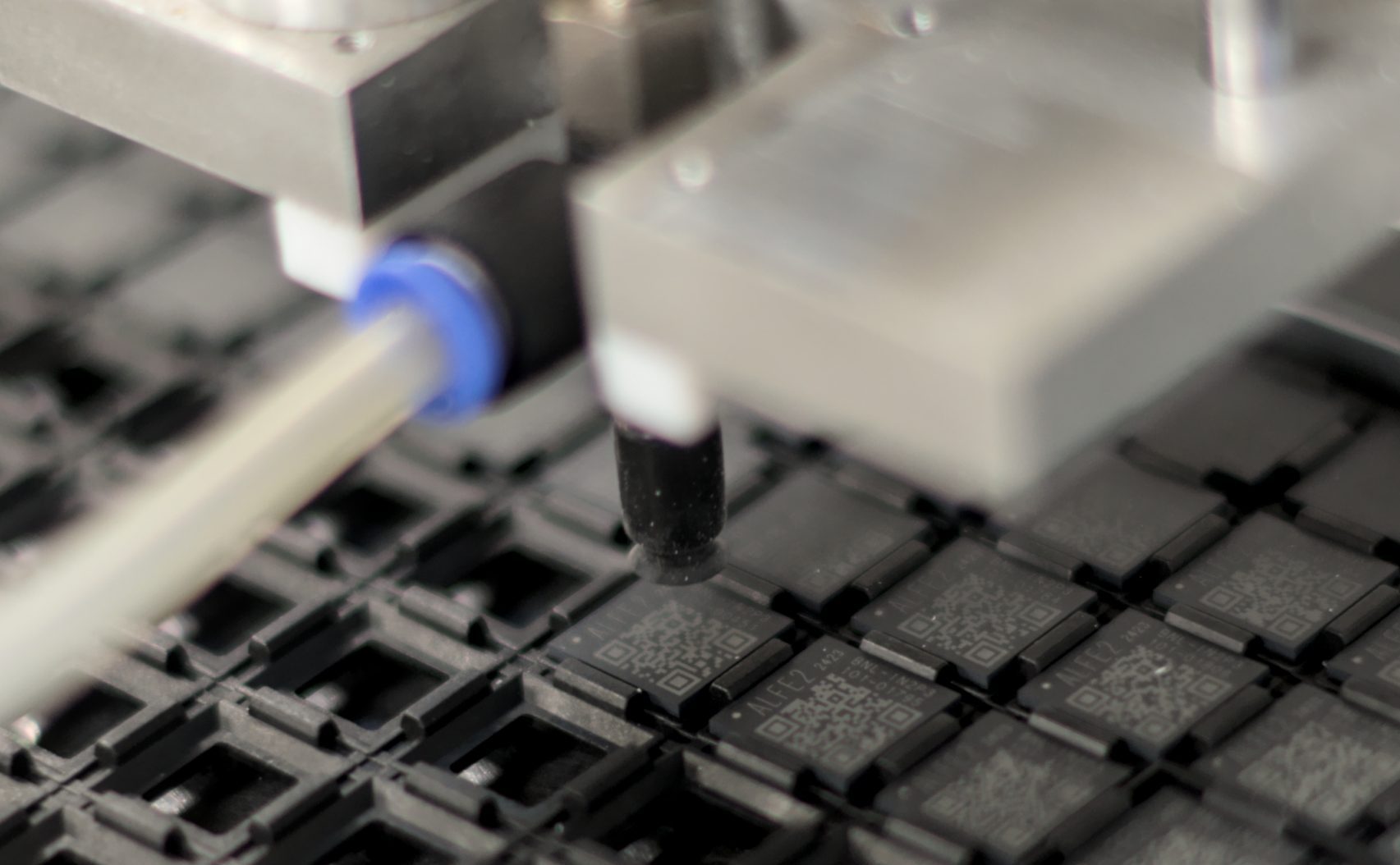
In a few days, CERN's Large Hadron Collider is set to enter a technical shutdown lasting more than three years. The goal: to prepare the transition to the High-Luminosity LHC (HL-LHC), which will substantially increase the number of collisions produced. To meet this challenge, the ATLAS detector must undergo a major overhaul. Photo : Nicolas Morange/IJCLab
At the centre of this transformation: the liquid argon calorimeter readout electronics. Designed in the 1990s, with the participation of IJCLab, and installed in the 2000s, they can no longer handle the data volumes or withstand the radiation levels that high luminosity entails. They must be entirely replaced.

Prototype of the ATLAS calorimeter installed at CERN, built in 1991 at IJCLab (ex Laboratoire d'Accélérateur Linéaire), Orsay. Photo : Dominique Longieras/IJCLab
Chips designed for extreme conditions
IJCLab took on the application-specific integrated circuits (ASICs) of the front-end electronics, tasked with amplifying and shaping the signals from the calorimeter. This work was carried out in collaboration with the Omega laboratory (CNRS Nuclear and Particles) and Brookhaven National Laboratory (BNL) in the United States.
Launched in 2016, the project engaged teams across every stage: defining specifications, and participating in successive rounds of prototype testing and characterisation. The final chip, named ALFE, is a joint design by BNL and Omega, manufactured in 130-nanometre technology by the foundry TSMC.
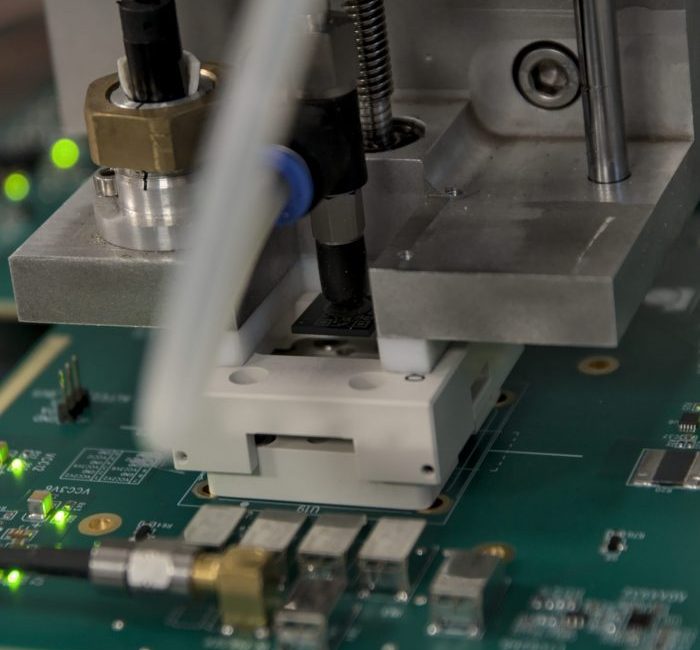
Close-up of an ALFE chip being inserted into a test socket. Photo : Nicolas Morange/IJCLab
40,000 chips tested in six months
Once the full production run had been ordered and encapsulated, the challenge was to test 80,000 ALFE chips and identify those fit for use in the detector: at least 50,000 had to meet specifications. IJCLab and BNL shared the task equally.
BNL supplied the electronic test boards. IJCLab developed the robotic system for handling, sorting and analysing the chips at scale. Two identical setups were deployed across the two laboratories.
Testing of the IJCLab batch began in late October 2025 and was completed in under six months: 40,000 chips examined, with 95% declared fit for service. A result that speaks to the quality of the production run.
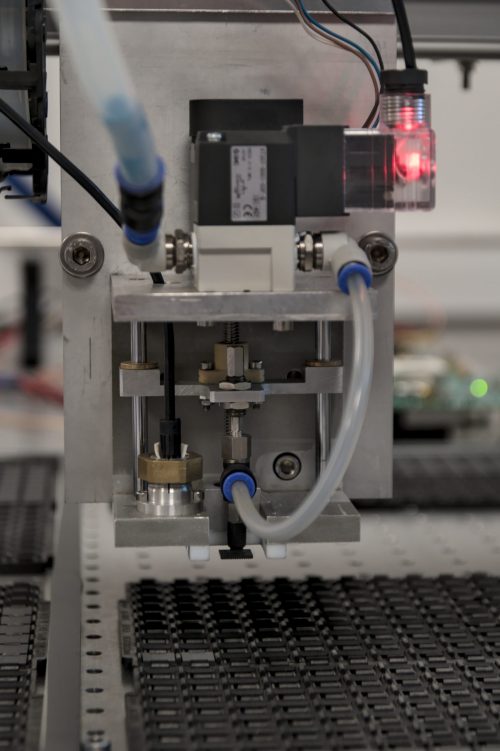
View of the robotic arm transporting an ALFE chip to its destination slot after testing. Photo : Nicolas Morange/IJCLab
What comes next: calibration boards and front-end boards
The robotic system will be quickly repurposed to test further circuits, this time destined for the ATLAS calorimeter calibration board. IJCLab teams will then turn their attention to the large front-end electronic boards, onto which the ALFE chips will be integrated.
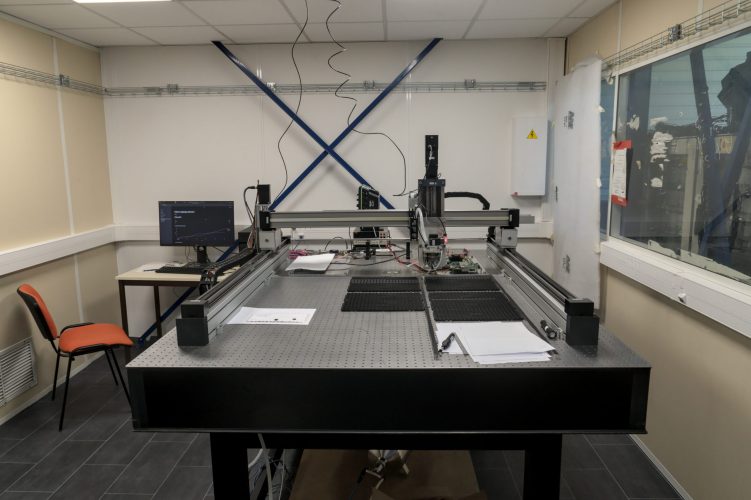
Overview of the ALFE chip testing robotic system. In the foreground at the bottom, a view of the vacuum tank used for the chip suction system. At the back left, the computer controlling the entire robotic and chip-testing setup, with the daily production monitoring page displayed. Under normal operating conditions, three trays of 189 chips are tested each day. Photo : Nicolas Morange/IJCLab